OMM Newsroom

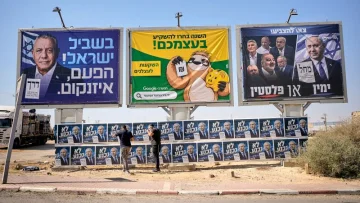
Israelis go to the polls on Tuesday in a closely contested parliamentary election that could end Prime Minister Benjamin Netanyahu’s long tenure or leave the country facing another political deadlock. Neither major bloc is projected to win the seats needed to govern, Anadolu Agency reported.
This is Israel’s first general election since the Oct. 7, 2023 attacks and the subsequent Israeli offensive in the Gaza Strip, as well as military confrontations with Lebanon and Iran. It is also the first general election held on schedule since 1988; successive governments have collapsed before completing their four-year terms over the intervening decades.
About 7.3 million people are eligible to vote, including approximately 1.2 million Palestinian citizens of Israel. Voting is scheduled at 12,018 polling stations, with around 18,000 ballot boxes deployed nationwide. Most polling stations will open at 7 am (0500 GMT) and close at 10 pm (2000 GMT). Election day is a public holiday.
Thirty-seven parties and electoral lists are competing for seats in the 120-member Knesset. A governing coalition needs the support of at least 61 lawmakers. Under Israel’s proportional representation system, voters choose parties rather than individual candidates, and parties must receive at least 3.25% of valid votes to enter parliament.
No party has ever won an outright majority in the Knesset, making coalition negotiations central to determining who becomes prime minister.
Eisenkot’s party narrowly ahead in final polls
Final surveys by Israel’s three main television broadcasters put Yashar, the centrist party led by former military chief Gadi Eisenkot, slightly ahead of Netanyahu’s Likud. The polls project Yashar will win 22 to 23 seats and Likud 19 to 21.
The B'Yachad, or Together, alliance, led by former prime ministers Naftali Bennett and Yair Lapid, is projected to place third with 14 or 15 seats. Other opposition parties include the Democrats, led by former general Yair Golan, and Yisrael Beytenu, led by former Defence Minister Avigdor Lieberman.
The three surveys forecast 50 seats for Netanyahu’s right-wing and religious bloc and between 52 and 56 for the opposition bloc. Palestinian-led parties are projected to win a combined 14 to 16 seats. The projections indicate that neither Netanyahu nor Eisenkot has a clear route to the 61 seats needed to form a government.
Winning the most seats does not automatically determine who becomes prime minister. President Isaac Herzog will consult the elected parties before tasking the lawmaker he considers most likely to command a parliamentary majority with forming a government.
Netanyahu and Eisenkot offer contrasting leadership bids
Netanyahu, 77, is seeking another term after serving as prime minister for more than 18 years across three separate periods. His campaign has emphasised national security, presenting his experience and military policies as essential to addressing regional threats.
He has faced criticism over his government’s failure to prevent the Oct. 7 attacks, its handling of the conflicts that followed and its opposition to an independent state commission of inquiry into the security failures. Netanyahu is also on trial on corruption charges, which he denies, and faces an International Criminal Court arrest warrant over alleged war crimes and crimes against humanity in Gaza.
Potential coalition partners for Netanyahu include far-right parties led by National Security Minister Itamar Ben-Gvir and Finance Minister Bezalel Smotrich, as well as the ultra-Orthodox Shas and United Torah Judaism parties. Ben-Gvir and Smotrich have advocated expanding illegal settlements in the occupied West Bank, opposed Palestinian statehood and encouraged Palestinians to leave Gaza.
The ultra-Orthodox parties have also faced growing criticism over their demands to maintain military-service exemptions for religious students, while the Israeli military contends with personnel shortages after years of conflict.
Eisenkot, 66, led the Israeli military from 2015 to 2019 and joined Netanyahu’s emergency government after the Oct. 7 attacks. He later left, criticising Netanyahu’s handling of the Gaza offensive and the lack of a clear political strategy. His son was killed while serving with the Israeli military in Gaza in December 2023.
Eisenkot’s campaign has focused on government accountability, political stability and restoring public confidence in state institutions. He supports an official inquiry into the Oct. 7 security failures and ending broad military-service exemptions for ultra-Orthodox men.
Although he presents himself as an alternative to Netanyahu, Eisenkot holds similar positions on several major security issues. He opposes establishing a fully sovereign Palestinian state under current conditions and says Hamas’ military capabilities and rule in Gaza must be dismantled.
The election offers voters competing approaches to leadership, governance, judicial independence and relations with far-right parties, while the two leading candidates share positions on key security issues.
Palestinian-led parties may influence coalition talks
The Joint List and Ra’am, the main parties representing Palestinian citizens of Israel, could become pivotal if neither major bloc reaches 61 seats. Polls project about nine seats for the Joint List and between five and seven for Ra’am.
A government led by Eisenkot could need support from one or both Palestinian-led parties, either as coalition members or through backing from outside the government. Such an arrangement would face political hurdles.
Lieberman has ruled out joining a government that depends on Palestinian-led parties, while other opposition figures have been reluctant to commit to such an agreement. Netanyahu has repeatedly raised the prospect of Palestinian-led parties influencing the next government as a way to mobilise right-wing voters.
Several outcomes are possible. Netanyahu could form another government if his bloc wins enough additional seats or attracts lawmakers from outside its current alliance. An Eisenkot-led coalition would likely require an agreement with Palestinian-led parties, defections from other camps or difficult compromises among opposition leaders with differing ideologies.
A unity government involving Likud and major opposition parties is another possibility, although Eisenkot and several allies have ruled out serving under Netanyahu. If no side secures a majority, Netanyahu could remain caretaker prime minister during prolonged negotiations, potentially leading to another election.
The performance of smaller parties polling near the 3.25% threshold could affect the balance of power. Parties that fall short win no seats, potentially weakening their political allies.
Exit polls are expected shortly after voting ends at 10 pm local time on Tuesday. Initial official results are due to emerge overnight, but counting ballots from military personnel, hospitals, prisons and other special voting arrangements could take several days.
Official results are scheduled to be published by Nov. 4. Coalition negotiations could then continue for weeks.