OMM Newsroom

Tel Aviv — Israelis head to the polls on October 27 with a familiar question: should Benjamin Netanyahu, the country’s longest-serving prime minister, remain in power?
Nearly every recent election has been seen as a referendum on Netanyahu. Many voters say this contest carries greater consequences than before, not only for who leads Israel but also for the direction of the country, CNN reported.
It is the first national vote since the Hamas-led attack on October 7, 2023, described as the deadliest security failure in Israel’s history, and the wars that followed in Gaza, Lebanon and Iran. The conflicts have mobilised much of the country and deepened Israel’s international isolation.
For many voters, the election is their first opportunity to judge the leadership in office during the failures of October 7, decide who should lead the country in wartime and consider who should bear the burden of increased military service.
Netanyahu’s outgoing government was the first in decades to complete a full four-year term. It relied on far-right and ultra-Orthodox partners, who pushed Israel in a more nationalist and religious direction. Netanyahu also became the first sitting Israeli prime minister to stand trial on corruption charges while his government pursued a judicial overhaul intended to weaken the Supreme Court and other checks on power. The effort triggered mass protests in 2023.
The election will help determine whether Israel continues along a nationalist, conservative and religious path or changes course. The result may remain uncertain for weeks as parties negotiate coalitions. Polls suggest neither Netanyahu’s bloc nor the opposition is likely to win a majority on its own, raising the possibility that the vote will usher in a new political crisis rather than resolve one.
Parties and coalition arithmetic
Israelis vote for party lists rather than individual candidates. Thirty-seven lists are registered this time, but only those that secure at least 3.25% of the vote win seats in the 120-member Knesset. Polls suggest 11 to 13 parties will clear the threshold, with seats allocated through proportional representation.
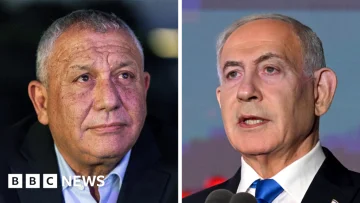
The two largest parties are Netanyahu’s right-wing Likud and Yashar, a new centrist party led by Gadi Eisenkot, a former military chief of staff and Netanyahu’s main challenger.
The latest Channel 12 poll gives Eisenkot 23 seats and Likud 21, though other pollsters differ. The pro-Netanyahu Channel 14 projects 30 seats for Likud and about 20 for Eisenkot. In head-to-head surveys on who is better suited to be prime minister, Eisenkot has maintained a consistent lead over Netanyahu.
Winning the most seats is not enough to form a government. A prime minister needs the support of 61 lawmakers, and no party has ever won that majority alone. Election night therefore often settles little; coalition negotiations can take days, weeks or even months.
Most polls give Netanyahu’s bloc 49 to 55 seats. It comprises Likud, two far-right parties led by Bezalel Smotrich and Itamar Ben-Gvir, and two ultra-Orthodox parties.
The opposition is fragmented despite its strength in polls. Eisenkot is flanked by parties led by former Prime Minister Naftali Bennett and former Defense Minister Avigdor Liberman on his right, and by the Democrats, led by Yair Golan, on his left. Bennett and Liberman have not endorsed Eisenkot and both aspire to become prime minister.
Polls suggest an alternative government would probably need the support or abstention of Arab parties, while several opposition leaders have ruled out cooperation with them. A deadlock, minority government, unity government or another election are all possible outcomes.
The result may hinge on which smaller parties cross the 3.25% threshold and how many votes go to lists that fall short. Turnout could determine whether a party enters parliament or becomes a pivotal partner capable of breaking the deadlock and reshaping the political map.
Arab voter turnout could be decisive. Palestinian citizens of Israel make up roughly 20% of the population and have traditionally voted at lower rates than the national average. In the 2022 election, turnout among Arab voters was 53.2%, compared with 70.6% overall. Pollsters expect it to exceed 60% this time, a rise that would make it harder for smaller parties to clear the threshold.
Several small parties in Netanyahu’s coalition are at risk, including Smotrich’s Religious Zionism and a new right-wing party led by Ofer Winter, a prominent retired military general. Most opposition parties are polling safely above the threshold, but another new, uncommitted party focused on reservists and economic issues is close to the 3.25% mark.
Israel does not allow citizens abroad to vote, except diplomatic staff. Official data indicate that more than 11% of the 7.3 million eligible voters — about 810,000 people — live outside the country. Thousands are planning to travel to Israel to cast ballots in person, potentially affecting the result.
Security, the economy and Palestinian issues
After years of war, security and accountability are major electoral issues. But polls also identify the cost of living as a leading concern, particularly among younger voters.
In the latest Channel 12 poll, 21% of Israelis named the economy and cost of living as their top priority, ahead of ultra-Orthodox conscription at 17%, the October 7 failure at 14% and the war with Iran at 10%. Priorities vary by political bloc: the war with Iran ranks first among Netanyahu coalition voters, at 21%, while the October 7 failure leads among opposition voters, at 28%.
A September survey by the Achord research center at Hebrew University found that 58% of voters aged 22 to 34 said the cost of living and housing prices would drive their vote, while 36% cited security issues.
The economy was not a central campaign issue until the weekend before the election, when Netanyahu put it at the top of the agenda. In an interview with Channel 10 focused on the economy, he addressed international condemnation of Israeli settlements in the West Bank and said Israel should prepare for possible international banking sanctions by developing “an economy that can circumvent them.” He said cryptocurrency and blockchain were being considered and that he had requested a plan.
The remarks drew sharp criticism from economists and a rare public rebuke from the Bank of Israel, which rejected the proposal, saying “cryptocurrencies cannot serve as a means of circumventing sanctions.”
Netanyahu’s main rivals said the proposal showed that he expected Israel to become more isolated. Eisenkot mocked it as “BibiCoin,” called it a “threat to national security” and accused Netanyahu of planning to “dismantle the Israeli economy for generations ahead.”
Netanyahu built his political career as a security hawk, but he was prime minister on October 7, 2023, when Hamas crossed into Israel, killing more than 1,200 Israelis and taking 251 hostages to Gaza. He has rejected personal responsibility and resisted calls for a state commission of inquiry into the security failures. His opponents have made accountability a central campaign issue.
The war also shapes Eisenkot’s personal story. His 25-year-old son, Gal, was killed fighting in Gaza in December 2023. Other party lists have recruited bereaved relatives and family members of former Israeli hostages as candidates. Opposition parties have also added reservists who recently fought in Gaza and Lebanon, bringing military service to the forefront of the campaign.
Most Jewish Israelis over 18 are subject to conscription, while ultra-Orthodox men have long had a blanket exemption for religious study. Netanyahu’s ultra-Orthodox coalition partners have sought to preserve and expand the exemption. The Israeli military says it is short of more than 12,000 personnel as it faces fighting on multiple fronts, while reservists fill the gap through repeated deployments lasting up to hundreds of days a year. All opposition parties have made universal service a central campaign pledge.
The outgoing government has been among the most hardline in Israel’s history on Palestinian issues, largely under the influence of two far-right nationalist leaders.
Smotrich, the finance minister who also oversees civil administration in the occupied West Bank, has pushed for a major expansion of settlements and withheld tax revenues from the Palestinian Authority, a move critics say could lead to its economic collapse.
Ben-Gvir, the national security minister, backed a death penalty law in the Knesset, tightened conditions for Palestinian prisoners and weakened police enforcement against Israeli settler violence in the West Bank. Both ministers opposed ending the Gaza war, support Israeli settlements in Gaza and advocate full annexation of the West Bank and Jewish control over it.
If Netanyahu returns to power with his current partners, that approach is likely to continue and intensify. Smotrich wants to cancel the Oslo Accords, dismantle the Palestinian Authority and wage war in the West Bank. Ben-Gvir, who has said he will seek the defence ministry in a new government, has called for Palestinians to leave Gaza and the West Bank.
An opposition government would probably not represent a radical ideological reversal and would change the tone more than the substance. Eisenkot, like Netanyahu, has rejected Palestinian statehood, and any opposition coalition would include right-wing parties opposed to concessions.