OMM Newsroom

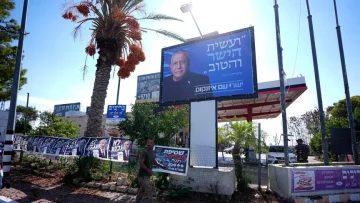
Israel’s general election is scheduled for Tuesday, 27 October, the first since the Hamas-led attacks on 7 October 2023 and the ensuing conflicts in Gaza and with Iran, Hezbollah and the Houthis. The BBC says the vote is widely seen as one of the most consequential in Israel’s history, with implications beyond the country.
Current polling puts incumbent Prime Minister Benjamin Netanyahu in a close contest with Gadi Eisenkot, a former head of the Israel Defense Forces.
Eisenkot’s military record and relative lack of experience in politics have contributed to his popularity. He formed the Yashar Party only last year. His son, a soldier, was killed in the first months of the Gaza war. Eisenkot served in Netanyahu’s war cabinet until resigning in 2024 over disagreements about the conflict, and has campaigned for accountability over the security failures that led to 7 October.
Other opposition leaders include former prime minister Naftali Bennett and Avigdor Lieberman, both right-wing politicians who take hardline positions on security and support permanent Israeli control over much of the occupied West Bank. Left-wing politician Yair Golan supports an Israeli withdrawal from large parts of the territory. Despite their differences, all could work with Eisenkot to form a government.
Netanyahu’s current government is the most right-wing in Israel’s history. To remain in power, he is likely to need support from some existing far-right coalition partners. Some advocate annexing the West Bank and the “migration” of Palestinians from Gaza, a policy that could amount to the forced displacement of civilians. Members of Netanyahu’s Likud party have also called for Palestinian “migration” from the territory.
Two Arab party blocs are also contesting the election. Arabs make up about one-fifth of Israel’s population, and many describe themselves as Palestinian citizens of Israel. In theory, the blocs could be kingmakers, but all but one of the leading Jewish parties have ruled out working with them.
How the election and government formation work
The Knesset, Israel’s parliament, has 120 seats. A government needs the support of at least 61 members to command a majority.
Israel uses proportional representation, so governments have always been coalitions of multiple parties. Forming the next government could take weeks or months as parties negotiate and seek concessions. If no bloc can secure a majority, a minority government is also possible.
At 22:00 local time on election day (20:00 GMT), Israeli broadcasters are expected to publish exit polls. The polls will offer an early indication of the result, but can vary significantly; current polling suggests there may be no clear projected winner. Preliminary results are expected the following day, with official results scheduled for 4 November.
After consulting party leaders, President Isaac Herzog will invite the leader he believes has the best chance of forming a government to try. The process can take more than a month. If the first attempt fails, Herzog may ask another leader to form a government; if that attempt also fails, Knesset members can ask him to give a third leader a chance. If that effort fails too, new elections will be called.
Israel held five separate elections between 2019 and 2022 as parties repeatedly struggled to work together.
Security, Gaza and the West Bank are central issues
Security has dominated the campaign. Netanyahu’s challengers have criticised the failures that led to the 7 October attacks, in which nearly 1,200 people were killed and 251 were taken to Gaza as hostages. Netanyahu has again presented himself as “Mr Security”, citing strategic victories in Israel’s wars since 2023.
Military conscription is another major issue. Ultra-Orthodox Jewish men engaged in full-time religious study have historically been exempt from military service, but the policy has become increasingly divisive since the war began.
Judicial reform has also featured prominently. Netanyahu’s government continues to pursue controversial changes to the judicial system, plans that prompted mass protests before 7 October. Critics say the reforms would undermine judicial independence and threaten democracy.
The cost of living is another key concern, with food and housing costs rising steadily in recent years.
A year after the Gaza ceasefire, Israel continues to carry out near-daily strikes in the territory, saying it targets Hamas operatives, and maintains control of more than half of Gaza.
More than 74,000 people have been killed in Israeli attacks on Gaza since 7 October 2023, according to the Hamas-run health ministry. The United Nations considers the ministry’s figures reliable.
In the West Bank, attacks by Jewish settlers are at a record level, according to UN records, while Israeli settlements—which are illegal under international law—are expanding rapidly. The composition of Israel’s next government is therefore a major factor in the lives of Palestinians.
On Gaza, the two leading camps, led by Netanyahu and Eisenkot, hold similar positions. Both support Donald Trump’s peace plan, under which Hamas would give up its weapons in exchange for a phased Israeli troop withdrawal from the territory. Eisenkot has recently pledged to end Hamas rule in Gaza within 18 months, using military means if necessary.
Netanyahu’s camp largely favours continuing the expansion of settlements in the West Bank. Eisenkot supports Israeli settlements in general but opposes moving ahead with the controversial E1 project, which would effectively split the West Bank in two. He also wants to close some unauthorised settler outposts built on Palestinian land, create conditions for a final peace settlement with the Palestinians and crack down on extremist Jewish settlers.
For decades, many mainstream Israeli politicians backed a two-state solution: an independent Palestinian state living peacefully alongside Israel. Netanyahu has long opposed the idea, and support for it has declined over the years. None of the leading Jewish parties is campaigning on a two-state solution in this election, and many have rejected it outright.