OMM Newsroom

Iran and the United States have yet to reach an agreement to end their conflict, while tensions around the Strait of Hormuz are rising, AnewZ reports. After Republican losses in the US midterm elections, Tehran says Americans have rejected the war. Qatar is stepping up mediation efforts to prevent a new escalation.
Iranian Parliament Speaker Mohammad Bagher Ghalibaf said on Wednesday that the results of the US midterm elections reflected growing public opposition to a war against Iran.
In a statement posted on the X platform, Ghalibaf wrote that Americans had rejected the conflict either because of moral concerns or the rising cost of living. He said Tehran supported the message sent by US voters: “Conscience or the cost of living — Americans said NO to war, and we support that message. If the US government betrays the will of its people to serve its international patrons and blackmailers, it will find that our ‘no’ becomes a nightmare.”
The remarks came after forecasts on Tuesday that Democrats would take control of both chambers of Congress. That would mark a major setback for President Donald Trump and the Republican Party.
Tehran and Washington differ over terms of a deal
Despite diplomatic efforts, Washington and Tehran remain divided over the terms of a possible agreement to end the conflict. A senior Iranian official said on Tuesday that the sides were still far from a deal.
The official spoke after Trump declined to rule out resuming US military operations following the midterm elections. Trump made the remarks in separate interviews while voting was under way in the United States. The war has become a major political issue in the country as public discontent grows.
A US official said the United States carried out what it called “defensive strikes” on Iran’s Qeshm Island overnight. The targets were “surface-to-air” missile systems allegedly used against US assets. Another US official described the operation as limited in scope and said it did not signal a return to large-scale military operations.
In an interview with Fox News, Trump repeated his warnings about possible military intervention. He said he did not want to cause mass casualties but would act if necessary. In a separate interview with the Financial Times, he said Washington was satisfied with the current situation: “It looks like we’re getting everything we want.” Trump also confirmed that indirect discussions over Iran’s stockpile of enriched uranium were continuing.
Trump also announced a new agreement with Israel involving Netanyahu. Under it, Washington will end about $4 billion in annual financial aid to Israel after this year, while continuing arms sales to its Middle Eastern ally. The announcement appeared aimed at addressing US voters’ concerns about American support for Israel amid the ongoing conflict.
Iran sets conditions for reopening the Strait of Hormuz
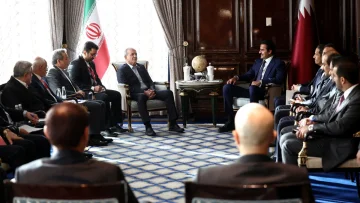
Qatar-led diplomatic efforts are continuing as Washington and Tehran exchange messages through mediators. A senior Iranian official said Qatari mediators travelled to Tehran late on Monday, November 2, to review a draft agreement that had been under discussion for about eight days.
According to the official, Iran is demanding the lifting of oil sanctions, an end to the US naval blockade and the release of frozen Iranian assets before agreeing to reopen the Strait of Hormuz.
Mohsen Rezaei, secretary of Iran’s Supreme National Security Council, said he did not consider Washington’s response to Tehran’s demands convincing. In a statement on X, he said the United States must respond explicitly to all seven of Iran’s conditions and take concrete steps to implement them. Rezaei said the Strait of Hormuz would open only if those demands were met.
Majid al-Ansari, a spokesman for Qatar’s Foreign Ministry, said Iran and the United States were reviewing proposals submitted by mediators. The Qatari delegation that had travelled to Tehran has returned to Doha, but diplomatic discussions are continuing.
Al-Ansari said regional partners were working intensively to avoid a new escalation and expressed hope that an agreement would be reached. An official familiar with the talks said Washington and Tehran were expected to respond within 36 hours. A senior Iranian official later said there was no set deadline for exchanging messages with mediators and reviewing the proposals.
The Islamic Revolutionary Guard Corps (IRGC) said on Wednesday that four oil tankers attempting to travel along a route it described as prohibited south of the Strait of Hormuz had struck sea mines and been destroyed. The IRGC said fires continued on the vessels after the explosions. The force also claimed that two other ships had been seized.
The incidents have heightened concerns about shipping safety and possible disruptions along a strategically important maritime route used for international energy supplies.