OMM Newsroom

School blockades, housing encampments and mass marches are putting pressure on governments across Europe, as protesters call for affordable homes, stronger public services and wages that cover everyday expenses.
The movements have different origins, but students, tenants and trade unionists have increasingly taken to the streets together. In some cities, demonstrations have been followed by arson, looting and clashes with police, prompting curfews and mass arrests, Anadolu Agency reported.
France and Italy: arrests and planned strikes
Protests began in September at schools in Creteil, a suburb of Paris, where teacher shortages helped spark student demonstrations and school blockades. Calls for more teachers, smaller classes and improved facilities broadened into protests over living costs and public services, drawing in trade unionists and Yellow Vest activists.
Several demonstrators were seriously injured during unrest in October. Two 17-year-olds were among them: one lost an eye and another lost a hand in a grenade explosion.
Interior Minister Laurent Nunez said 550,000 people took part in 110 demonstrations nationwide on Oct. 17, including 110,000 in Paris. Organizers put the national turnout at 800,000, according to Le Monde.
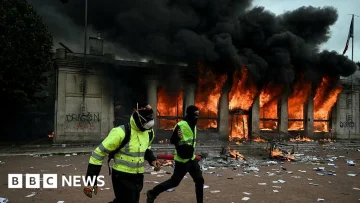
Peaceful marches were followed by clashes, looting and attacks on public buildings in several cities. In Limoges, people set fire to the historic town hall at the end of a demonstration, devastating the building. French authorities said around 3,000 businesses were affected by weekend violence and nearly 1,000 security personnel were injured.
Justice Minister Gerald Darmanin said 2,513 people had been taken into custody after the weekend unrest. On Monday, protesters also blocked an entrance to the Louvre in Paris. Authorities imposed localized overnight curfews in parts of Paris, Lyon and other cities.
Prime Minister Sebastien Lecornu said the restrictions helped restore calm and promised a larger police deployment for further demonstrations planned for Oct. 24.
In Italy, student protests gained momentum in early October over inadequate education funding and deteriorating school conditions. The demonstrations have coincided with discontent over wages, energy costs and public services.
The CGIL trade union and allied associations are seeking stronger public health care and education, better pay and action against insecure employment. They also oppose higher arms spending and want government resources directed toward social needs.
CGIL leader Maurizio Landini said more than 100,000 people attended a union-backed rally in Rome on Oct. 17, according to public broadcaster RAI. He called for a tax on large fortunes and announced a general strike for Nov. 20.
Separately, weekend unrest near Milan’s cathedral involved burning bins, smashed windows and looted shops. Corriere della Sera, citing public security sources, reported that police took 271 people to headquarters after the Oct. 18 unrest and formally arrested 32, including 23 minors.
Prime Minister Giorgia Meloni condemned the violence. On Tuesday, she announced that 500 troops would be deployed to Milan to assist police. She said the Cabinet had also approved measures to make it easier to detain minors and to fine parents for damage caused by their children.
Housing protests in Belgium, Spain and Portugal
Student protests spread to French-speaking Belgium on Oct. 1, following mobilizations in France, with Liege emerging as an early centre of demonstrations. Students oppose education cuts, rising study costs and reforms they fear will make higher education less accessible. Their concerns overlap with broader union opposition to government austerity measures.
Police said several hundred people demonstrated in Brussels on Oct. 17, while 200 to 250 joined a separate march in Liege. Police reported 195 arrests across the two cities during that day’s protests, which involved clashes, barricades and property damage. Officers used tear gas and water cannons.
In Spain, the eviction of 87-year-old Maricarmen Abascal from her longtime home in Madrid became a focus of anger over housing affordability. An encampment was set up in Puerta del Sol on Sept. 26, and demonstrations and encampments spread to other cities as campaigners called for affordable rents and stronger protection against forced evictions.
Government estimates put attendance at the Oct. 3 march in Madrid at 70,000, while the Madrid tenants’ union claimed 500,000. More than 50 protests were called across Spain that day. Tenant organizations have also called for restrictions on investment funds buying residential property and wider industrial action over housing.
After parliament rejected two government housing decrees, Prime Minister Pedro Sanchez announced an early election for Nov. 29. Housing encampments remain in place. Five people were arrested after clashes at the end of the Oct. 3 demonstration in Valencia, broadcaster Onda Cero reported.
Major unions and tenant organizations have called a housing-related general strike for Nov. 11, taking their demands beyond street demonstrations and into workplaces and the economy.
In Portugal, housing encampments formed in October as protesters challenged rising rents and living costs, alongside union demands for better pay, pensions and public services. Demonstrations took place in Lisbon, Porto and Coimbra on Oct. 17. The organizing union CGTP said “many tens of thousands” joined the Lisbon march; police did not provide a crowd estimate.
Housing activists joined the demonstrations, linking their campaign to workers’ concerns about the gap between incomes and everyday expenses. Activists began occupying Lisbon’s Rossio square on Oct. 17, pitching around 200 tents. They had also been at Porto’s Dom Joao I square for about 10 days.
Police cleared housing protest encampments in Lisbon and Porto before dawn on Oct. 20. In Lisbon, 55 people were arrested for alleged disobedience. No arrests were reported during the clearance in Porto, where demonstrators complied with instructions to leave.
The clearances did not end the protests: thousands returned to squares in both cities that evening, and an assembly in Lisbon voted to pitch tents again. Those detained were subsequently released pending a court appearance.
Housing activists are demanding the withdrawal of legislation that would ease evictions and remove rent caps on new leases. CGTP is also calling for controls on essential prices and higher wages and pensions. Its planned actions include a gathering outside parliament on Nov. 24, during the final budget vote.