OMM Newsroom

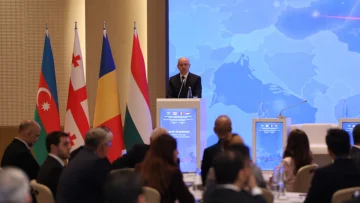
Russian President Vladimir Putin is attending the eighth summit of the Gas Exporting Countries Forum (GECF) in Moscow, AnewZ reports. The Kremlin said leaders will discuss the role of natural gas in global energy security and adopt a final declaration.
Iranian President Masoud Pezeshkian traveled to Moscow to meet Putin and attend the summit. Azerbaijan, a GECF observer country, is also expected to address the forum.
About the GECF
The GECF is an international organization bringing together leading natural gas-producing countries. It was established in Tehran, Iran’s capital, in 2001. Its charter was signed in Moscow in 2008, and it became a fully fledged organization after establishing its permanent office in Doha, Qatar’s capital. The GECF’s stated aim is to support member countries’ sovereign rights over their gas reserves.
The organization has 12 full members and eight observer countries. Its full members are Algeria, Bolivia, Egypt, Equatorial Guinea, Iran, Libya, Nigeria, Qatar, Russia, Trinidad and Tobago, the United Arab Emirates and Venezuela.
The observer countries are Angola, Azerbaijan, Iraq, Malaysia, Mauritania, Mozambique, Peru and Senegal.
How has the war in Ukraine affected Russia’s gas trade?
According to the European Commission, Russian gas imports into the European Union (EU) fell from 152 billion cubic meters in 2021 to 36 billion cubic meters in 2025. Most pipeline supply routes have been closed. The Nord Stream pipelines were blown up in 2022, while the Yamal-Europe route halted operations amid a dispute between Poland and Russia.
Gas transit through Ukraine stopped on Jan. 1, 2025, after the transit contract expired. Reuters estimates that Russia’s pipeline gas exports to Europe fell 44% in 2025 to their lowest level since the mid-1970s. TurkStream, which runs from Russia to Türkiye, is currently the only direct, operational pipeline delivering Russian gas to Europe.
According to the International Gas Union, a global representative of the gas industry, Norway overtook Russia in 2025 to become the world’s largest exporter of pipeline gas.
Iran’s position in the gas market
Iran has the world’s second-largest gas reserves after Russia. However, U.S. sanctions have slowed the development of the country’s export capacity. The U.S.-Iran war, which began in February, has also caused major changes in the gas market.
Iranian attacks damaged gas infrastructure in the Persian Gulf. A strike on Qatar’s Ras Laffan complex in March caused serious damage to two production lines and knocked out about 17% of the country’s liquefied natural gas (LNG) export capacity. Reports say Qatar’s supplies have fallen sharply because it has been unable to export through the Strait of Hormuz.
About one-fifth of global LNG exports usually pass through the strait. European gas prices fell 18% after a ceasefire was agreed on April 8. However, transit through the sea route remains disrupted. Qatar and Iran are both GECF members, placing both sides of the dispute in the same forum.
Azerbaijan’s position at the forum
As an observer country, Azerbaijan does not have voting rights in the GECF. Azerbaijan’s Energy Minister Parviz Shahbazov spoke about the role of gas at Monday’s ministerial meeting. He addressed challenges in the global gas market, gas’s importance to energy security, investment needs and Azerbaijan’s gas policy.
“Investment decisions must be made today to ensure reliable gas supplies tomorrow,” Shahbazov said.
Shahbazov added that geopolitical tensions, security risks along supply routes and changing energy policies are increasing uncertainty. He described the Southern Gas Corridor, a project that delivers Azerbaijani gas directly to European markets, as a successful model of cooperation.