OMM Newsroom

A meteorite discovered in Mali in 2022 formed more than 4.1 billion years ago, offering scientists rare insights into Mars’ ancient crust and water history, according to a study reported by Anadolu Agency.
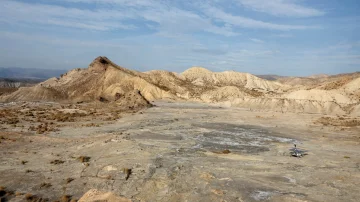
Known as Teghaza 001, the meteorite weighs about 800 grams and was found in the Sahara Desert. Researchers funded by NASA determined that it came from Mars and is among the oldest Martian meteorites ever discovered on Earth.
Named after the salt plain in Mali where it was found, Teghaza 001 is one of about 435 known Martian meteorites. The findings were published Thursday in the journal “Science,” NASA’s Jet Propulsion Laboratory said.
The study provides an initial analysis of the meteorite, which contains a distinctive combination of igneous, or volcanic, minerals. They offer clues to how Mars’ crust formed as magma cooled and was later altered by water beneath the surface. A separate study published in “Science Advances” in June examined the meteorite’s water content and what it could reveal about the planet’s early surface.
“It was only after we started looking closely that we realized this meteorite is really unique,” said Yang Liu, the study’s lead author and a researcher at NASA’s Jet Propulsion Laboratory in Southern California. One reviewer of the paper called it “a Rosetta Stone for Mars,” Liu said.
Teghaza 001 is among the three most ancient Martian meteorites found on Earth. The others include ALH84001, which is made almost entirely of one mineral and is of a similar age, and “Black Beauty,” which formed about 2.1 billion years ago.
The meteorite’s mineral composition resembles material observed by NASA’s “Mars Reconnaissance Orbiter” in the planet’s cratered southern highlands. Its precise origin is unknown, but researchers identified several possible locations that match its mineralogy and chemistry.
“This is really our first piece of Martian crust from a part of Mars we’ve never had a sample of before,” said Lee Saper, the study’s second author. Saper conducted the research as a postdoctoral scholar at NASA’s Jet Propulsion Laboratory and is now a scientist at NASA’s Ames Research Center in Silicon Valley.
“It records interactions of water and rock and maybe even an imprint of the Martian atmosphere as it was losing water,” Saper said.
Minerals and dating reveal ancient water activity
Researchers at the University of New Mexico first identified Teghaza 001 as Martian by analyzing its oxygen isotopes, which serve as geochemical fingerprints. It appeared to belong to the shergottite class, the most common type of Martian meteorite.
Liu later noticed unusual textures and minerals that warranted further study. Her team found zircon crystals, which preserve information about how a rock formed and help scientists determine its age.
Francois Tissot, a co-author from the California Institute of Technology, helped apply an in-situ rubidium-strontium dating technique developed by his team. The method analyzes individual mineral grains using a fragment smaller than a fingernail, leaving most of the rare meteorite available for future research.
“Right now, we are one of very few labs in the world able to perform this kind of age-dating, and the first to date such an ancient Martian meteorite,” Tissot said. “Our hope is to pave the way for dating even more Martian meteorites, or samples returned from other planets, their moons and asteroids.”
The results indicate that water altered the rock around 4.1 billion years ago, suggesting it formed even earlier. Its oxygen isotopes, texture and chemistry point to a dynamic water cycle on early Mars.
Researchers said further study of Teghaza 001 could help clarify how water interacted with rocks and shaped Mars’ early geological history. “We’ve only scratched the surface,” Liu said.