OMM Newsroom

France will deploy troops to support police and launch a large-scale security operation ahead of protests planned for Saturday, the government said. It also acknowledged shortcomings in its response to violence over the previous weekend, AnewZ reported.
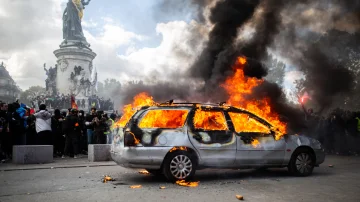
Prime Minister Sébastien Lecornu said security forces would be deployed in “massive” numbers on Saturday. He said the immediate priority was to restore public order following riots and looting in Paris, Marseille, Lyon and other cities on October 17.
Interior Minister Laurent Nuñez told parliament, during heated debate, that troops would be stationed alongside police. After widespread criticism that city centres had been left unprotected, the government pledged to review its security measures.
Lecornu framed the crisis as a choice “between violence and the Republic” and blamed far-left groups for the riots. Those groups, in turn, accused the government of failing to take seriously public discontent over rising living costs and declining public services.
The scale of the unrest and the police’s difficulty in containing it have caused concern in France. Tensions have also been heightened by strong polling results for far-right and radical left candidates ahead of next year’s presidential election.
Protests in other European countries, including Italy and Albania, have fuelled concerns that discontent over living standards could spread across the continent. France and several other countries are facing budgetary pressures.
Relative calm has returned in France after local curfews were imposed in several riot-hit areas. The government said the measures had helped restore control. In some areas, curfews covering children and teenagers under 18 were extended until Tuesday night.
Lecornu acknowledged shortcomings in the state’s response over the weekend. He said there had been failures in intelligence gathering, police deployments had been too static and it had been a mistake not to cancel planned police leave.
Suspect detained over fire at Limoges city hall
Parliament is setting up an inquiry commission to investigate the causes of the riots. Authorities have assigned 200 investigators to identify and locate people involved in street violence.
On Tuesday, police detained a suspect accused of starting the fire that destroyed the historic city hall during unrest in Limoges, in central France. Officials said the suspect was on a security watch list and belonged to a far-left group.
France’s largest student organisation, UNEF, has called for new protests on Saturday. It said it would continue pressuring the Macron government over the education system, which it says is facing cuts in funding and deteriorating conditions. “We’re carrying on,” UNEF posted on social media.
Groups calling themselves the “Yellow Vests” have also urged protests against rising fuel prices.
Italian government considers new security measures
Riots also broke out last weekend in cities in northern Italy, including Milan, the country’s financial hub. Although the unrest was not on the same scale as in France, it shook Prime Minister Giorgia Meloni’s government. The Cabinet was expected to discuss new security measures at a meeting on Tuesday.
Defense Minister Guido Crosetto described the riots as a form of “hybrid warfare”, saying they were being carried out through TikTok, YouTube and other online platforms.
“What is happening in Milan and elsewhere in Italy is fundamentally different from what we have seen in the past. The West has not yet understood this and has not taken meaningful measures in response,” Crosetto wrote on X.
In a separate post, he said his adviser Matteo Perego had been working for several days with the ministry’s legal offices on legislation that would allow more troops to support police forces in Milan. Crosetto said it was easy to announce an increase in troop numbers without specifying what the soldiers would do or how they would do it. For the move to be meaningful, he said, the Cabinet should approve rules the following day: troops should be able to act for three months, only in support of the Carabinieri, police and Finance Guard, and with police powers in situations such as those observed during the unrest.
The On sportswear store and a Levi’s shop on Milan’s Corso Vittorio Emanuele II, which were targeted during the riots, reopened on Tuesday, although their windows remained boarded up. Luxury retailers returned goods to their display windows after temporarily removing them as a security precaution.
In Albania, demonstrators were expected to take to the streets of Tirana on the seventh day of protests against Prime Minister Edi Rama’s government.