OMM Newsroom

Leaders of the Organization of Turkic States (OTS) have gathered in Ankara for its 13th summit, AnewZ reports. Türkiye is due to take over the rotating chairmanship from Azerbaijan, and member states will discuss deepening economic, political and defense ties.
The agenda includes strengthening political and economic relations, expanding defense cooperation and improving transport links between Asia and Europe. The summit is also expected to appoint a new secretary-general of the organization.
Held under the theme “Unity in language, thought and action in the Turkic century,” the summit reflects Türkiye’s initiative to boost cooperation among Turkic states and strengthen their joint positions on the international stage.
During Türkiye’s chairmanship, priorities will include improving the organization’s human and financial resources and strengthening coordination among institutions working on Turkic cooperation. Kursad Zorlu, deputy chair of Türkiye’s ruling Justice and Development Party, said proposals under consideration include a shared museum pass for member states, joint service desks at airports, a common e-commerce platform and closer cooperation in football.
The summit coincides with Türkiye’s 103rd Republic Day, celebrated on Oct. 29. Ankara has also been named the Turkic world’s tourism capital for 2026.
Founding of the organization and summit participants
The OTS was established in 2009, when Azerbaijan, Kazakhstan, Kyrgyzstan and Türkiye signed the Nakhchivan Agreement in Azerbaijan’s city of Nakhchivan. The agreement laid the groundwork for deepening political, economic and cultural cooperation among Turkic-speaking countries.
Leaders of Turkic states had met before, but the agreement led to the creation of the first formal organization. It was initially called the Cooperation Council of Turkic-Speaking States. Uzbekistan became a member in 2019, and the organization adopted its current name in 2021.
The OTS currently has five full members: Azerbaijan, Kazakhstan, Kyrgyzstan, Türkiye and Uzbekistan. Hungary, Turkmenistan and Cyprus hold observer status. Hungary became an observer in 2018 under Viktor Orban’s government, which sought to strengthen ties with Turkic countries.
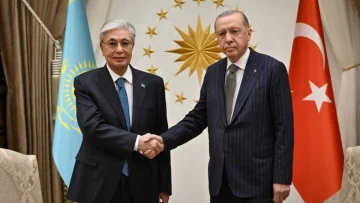
Four of the five full-member countries are represented by their leaders at the Ankara summit. Azerbaijan is represented by Foreign Minister Jeyhun Bayramov. Kazakhstan’s President Kassym-Jomart Tokayev, Kyrgyzstan’s President Sadyr Japarov and Uzbekistan’s President Shavkat Mirziyoyev are attending. Turkish President Recep Tayyip Erdogan is hosting the event.
Observer Turkmenistan is represented by President Serdar Berdimuhamedov, while Cyprus is represented by Foreign Minister Tahsin Ertugruloglu. AnewZ has contacted Hungary’s Ministry of Foreign Affairs to clarify who will represent the country at the summit.
Trade, travel and security cooperation
Boosting trade is a key priority as Türkiye seeks to deepen economic and political ties with the Turkic world. Figures cited by Zorlu show that Türkiye’s exports to the other four full members rose from $6.2 billion in 2021 to $9.6 billion in 2025. Imports increased from $4.2 billion to $7.3 billion, bringing total trade to about $17 billion.
Kazakhstan was Türkiye’s largest export market among the four countries, with exports worth $3.2 billion. Azerbaijan ranked second at $3 billion. Exports to Uzbekistan reached $2.1 billion, while those to Kyrgyzstan totaled $1.3 billion.
Easing travel restrictions is also among the proposals under discussion. Zorlu said in October that officials were exploring whether citizens of Turkic states could travel between them using national identity cards instead of passports. Speaking at the Turkic World Youth Meeting in Kocaeli province in northwestern Türkiye, he said: “We are trying to lay the groundwork and create the conditions to see whether we can travel with our identity cards.” The proposal remains under discussion, and no formal agreement has been reached.
The summit is taking place amid growing debate over the organization’s future role in regional security and defense. At the OTS’s previous summit in Gabala, President Ilham Aliyev called for stronger defense cooperation among member states.
“Clearly, development is impossible without ensuring security. At a time when the norms and principles of international law are being seriously violated, cooperation among our countries in military and defense-industrial fields is becoming one of the key factors,” Ilham Aliyev said.
Ilham Aliyev is not attending the Ankara summit; Azerbaijan is represented by Jeyhun Bayramov. Recep Tayyip Erdogan has also stressed the importance of closer cooperation in cybersecurity and the defense industry.
However, not all members support the organization taking on a broader geopolitical role. Kazakhstan’s President Kassym-Jomart Tokayev has rejected the idea of the OTS becoming a geopolitical bloc.
“Strengthening the unity of the Turkic world is a very important and urgent priority for us. The Organization of Turkic States is not a geopolitical project or a military organization. It is a unique platform that strengthens trade, economic, high-tech, digital, cultural and humanitarian cooperation among brotherly countries,” Tokayev said in May.
Questions have also arisen about Hungary’s future ties with the organization following a change of government earlier this year. Prime Minister Peter Magyar has refocused the country’s foreign policy on the European Union.
Despite differing views on the organization’s future direction, analysts expect the Ankara summit to strengthen cooperation among members. Turan Gafarli, a nonresident researcher at the Topchubashov Center in Baku, said the summit would highlight a growing sense of unity. He said this was a long-term process and that the OTS was becoming a political structure developing the capacity to act jointly in response to international events.