OMM Newsroom

France is preparing for further nationwide demonstrations after student protests over school conditions expanded into a movement focused on rising living costs and strained public services.
After weeks of demonstrations, mass arrests and clashes, the government announced education concessions and tighter security measures. Anadolu Agency reported the following timeline of the protests and the authorities’ response.
School protests spread and converge with cost-of-living rallies
School blockades over poor learning conditions began in the overseas territories of Mayotte and French Guiana before similar protests appeared on the mainland. In mid-September, students in Paris suburbs mobilized over vacant teaching posts, overcrowded classes, deteriorating buildings and shortages of support staff.
Students reported classes of up to 36 and months without teachers in core subjects. They also called for changes to France’s university admissions platform.
By Sept. 29, protests had affected about 180 schools, and the Interior Ministry reported 164 arrests. On Oct. 1, activity had spread to 1,027 schools, including 222 blockades. A fire broke out at Nelson-Mandela High School in Nantes, while authorities recorded 1,949 arrests nationwide amid unrest.
On Oct. 5, a 15-year-old student lost a hand when a stun grenade exploded during a protest in Lens. Authorities then suspended the grenade model’s use at student demonstrations pending an investigation.
Justice Ministry figures showed 6,059 arrests between Sept. 28 and Oct. 5, with 5,060 people placed in police custody. Minors made up 87% of those detained.
The Interior Ministry estimated that 266,000 people demonstrated nationwide on Oct. 6, including 56,000 in Paris. Student and university organizers put turnout at 450,000. The ministry reported 488 arrests.
Demonstrators increasingly raised issues beyond education, including inequality, public spending and public services. By Oct. 9, more than 6,800 people had been placed in custody since the movement began; 86% were minors. Twenty-one people had been placed in pretrial detention.
Meanwhile, social media campaigns called for nationwide demonstrations on Oct. 17 over fuel prices and the cost of living. The appeals recalled the Yellow Vest protests that began in 2018, and prominent figures from that movement backed the mobilization, though its leadership remained unclear.
Workers, farmers, pensioners and residents of disadvantaged neighborhoods were urged to gather at roundabouts, petrol stations and toll roads. Student groups also planned to take part, bringing overlapping grievances into the streets while maintaining separate demands and organizing structures.
Arrests, clashes and government response
The Interior Ministry estimated that 550,000 people took part in demonstrations nationwide on Oct. 17, while the CGT trade union put the figure at 800,000.
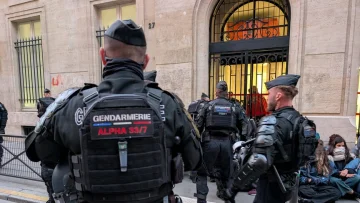
Many marches were peaceful, but some groups clashed with police, threw projectiles, set fires and looted businesses. Police used tear gas. In Limoges, fire severely damaged the historic city hall; in Marseille, demonstrators broke into the city hall; and Lyon’s tourist office was set on fire. Damage and clashes were also reported in Paris and other cities.
Authorities later reported 2,628 arrests, 1,144 injured security personnel and 1,522 businesses damaged or looted. The arrests did not all lead to charges or convictions. In the Paris region, prosecutors reported 855 arrests over the weekend, with 557 people placed in police custody. Authorities reported 101 arrests in Marseille and 199 in Lyon.
Prime Minister Sebastien Lecornu blamed radical left-wing groups and criminals. President Emmanuel Macron condemned the violence and called for prosecutions.
Jean-Luc Melenchon, the France Unbowed presidential candidate who joined the Paris march, described police command decisions at the protest as “aberrant”. He denied that his supporters had engaged in looting or destruction and urged the government to address young people’s anger.
Marine Le Pen of the far-right National Rally also accused France Unbowed of fueling the violence. In a video address, she described Macron’s government as exhausted and disoriented and said France was caught “between violence and powerlessness”. She called for calm and expressed support for the security forces.
Interior Minister Laurent Nunez acknowledged that authorities had failed to anticipate the scale of the protests and had lost control in some areas. Macron rejected Nunez’s offer to resign and called for an examination of intelligence and security failures. The government also prepared assistance for affected businesses.
Authorities introduced targeted curfews, including restrictions on minors, and announced that 70,000 police officers and gendarmes would be deployed for the Oct. 24 protests, up from 60,000 on Oct. 17. On Oct. 23, Macron met student representatives to discuss school conditions and Parcoursup, France’s national web platform for pre-registration and admissions to first-year undergraduate and higher education programmes.
The Interior Ministry counted 410,000 demonstrators on Oct. 24, including 110,000 in Paris. The CGT estimated turnout at about 800,000 nationwide and 250,000 in the capital. Authorities recorded 289 demonstrations, compared with 441 a week earlier.
Most marches passed without major incidents, but clashes broke out toward their end. Police used tear gas and water cannons in Paris, Nantes and Lille after some demonstrators threw projectiles. Further looting and damage were also reported.
In Paris, police reported 65 arrests and more than 3,000 identity checks. In Lyon, where demonstrations were banned in parts of the city, authorities reported 36 arrests and 22 people injured, including 18 security personnel. In Nantes, six people were arrested in connection with looting, according to the Loire-Atlantique prefecture.
On Oct. 26, Nunez announced 1,435 arrests and said 267 security personnel and 150 demonstrators had been injured during that weekend’s demonstrations. An Interior Ministry assessment recorded 75 fire-related interventions, down from 2,025 the previous Saturday.
Authorities said three protesters were seriously injured in Toulouse, Clermont-Ferrand and Reims. An investigation was opened into the incident in Toulouse.
That day, the government announced measures in response to concerns raised during the protests. It said Parcoursup would be replaced in 2028, changes would be introduced for the 2027 admissions cycle and 15,000 additional higher education places would be created.
First-year high school classes would be capped at 28 students, beginning in half of the most disadvantaged schools in 2027 and extending to all public high schools in 2028. The government also pledged to cancel 836 planned secondary education job cuts and add 500 teaching posts.
Other commitments included €4 billion ($4.47 billion) in loans for school renovations, €1 billion in campus investment and student grants that would rise in line with inflation from 2027.
Student representatives welcomed some announcements but said questions remained about university capacity and the replacement admissions system. The group Les Lycéens! maintained its call for further action.
Further demonstrations were called for Oct. 31, while trade unions announced a nationwide day of action for Nov. 5. Nunez said another 70,000 police officers and gendarmes would be deployed on Oct. 31 and warned of a high risk of violence around Halloween.
Authorities planned to restrict gatherings in city centers where they considered the risks to public order too high, directing some demonstrations to outlying areas. With France approaching its 2027 presidential election, the unrest has intensified debate over education, living costs, public services and policing.