OMM Newsroom

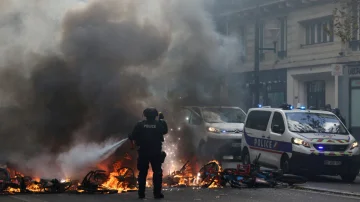
Police were deployed in Paris on Saturday. AnewZ reported that a curfew would be imposed in the city’s République and Châtelet-Les Halles areas from 11 p.m. on Oct. 31 until 6 a.m. on Nov. 1.
The protests, held on Halloween, were largely peaceful during the afternoon. They followed riots and looting on Oct. 17, which caught security forces off guard and damaged shops, public buildings and businesses across the country.
320,000 people take part in protests
At the end of the march in Paris, riot police intervened to disperse groups of rioters who had split off from the main crowd. Tear gas was used in Lyon, France’s third-largest city, and Toulouse in the southwest. Tensions arose after unauthorized demonstrations in Marseille, but the situation calmed by evening.
Interior Minister Laurent Nuñez told journalists after the marches that security forces had held their positions and defended city centers. Public order was maintained, he said, while police faced “numerous acts of violence.”
According to France’s Interior Ministry, 320,000 people took part in demonstrations nationwide, including 70,000 in Paris. The turnout was 410,000 the previous Saturday and 550,000 on Oct. 17.
In a statement, the ministry said “radical elements” had broken away from marches in cities including Bordeaux, Toulouse, Lyon and Marseille, seeking to cause damage and loot, but security forces had prevented them from doing so. Checks at railway stations and on roads also uncovered objects that could be used as weapons.
The protests in France have influenced youth-led “Gen-Z” demonstrations in other European countries. Demonstrations were also held in several German cities and in Italy on Saturday.
Protesters voice opposition to rising living costs
Students, who began mobilizing in September, marched alongside trade unions and a smaller contingent from the Yellow Vests movement. Participants voiced their dissatisfaction with rising living costs, higher fuel prices, inflation and President Emmanuel Macron’s government.
Protester Jerome Rodrigues said during the march in Paris that the French economy was in poor shape. He said the country was run by a group he considered incompetent that managed billions, while families struggled over small amounts of money.
Left-wing leader Jean-Luc Mélenchon, whose ratings have risen in recent weeks ahead of the presidential election scheduled for April, led the Paris demonstration. Polls show far-right leader Marine Le Pen in the lead ahead of the election, while potential centrist successors to Macron remain divided.
France’s highest administrative court upheld a ban on a march between Paris’s Place de la Nation and Place de la Bastille, despite objections from trade unions. Authorities instead authorized a route along boulevards on the eastern edge of the capital, away from central shopping districts.
Authorities warned that rioters could use Halloween masks to conceal their identities. Interior Minister Laurent Nuñez said he would not allow a repeat of the violence on Oct. 17. He said existing laws allow police to ban face coverings when public order is threatened.
The U.S. Embassy advised travelers to avoid areas where demonstrations or large gatherings were planned.
The protests intensified after Macron’s minority government began talks in late September on the 2027 budget. Students’ discontent has grown over deteriorating school conditions, overcrowded classrooms and a university admissions system they consider unfair. Trade unions and the Yellow Vests movement, which is demanding measures to address living costs, later joined them.
The French government’s pledges to reform education and ease fuel costs have not quelled dissatisfaction. Aaron Berthier de Grandry, a 15-year-old student from Nogent-sur-Marne near Paris, said he planned to join protests for a third consecutive weekend: “When I was a child, I was told that young people were the future.”
Data released on Friday showed that France’s economy was already shrinking in the third quarter. Ratings agency Fitch also unexpectedly revised its outlook on French debt to negative on Friday. Public debt approaching about 120% of the economy and rising borrowing costs have increased pressure on Macron’s government to cut spending and limited its room for maneuver.
Retail-sector losses during three weeks of unrest exceeded 1 billion euros ($1.1 billion), according to the Chamber of Commerce’s estimate. Other estimates put the total at twice that amount when uninsured damage and lost revenue are included.