OMM Newsroom

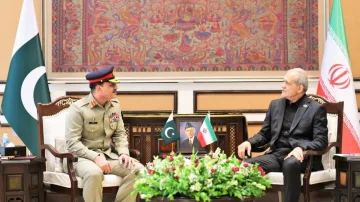
Iran hosted senior security and defense officials from Saudi Arabia, Pakistan and Türkiye in Tehran on Oct. 26. The four-way meeting, held amid rising tensions in the Middle East, focused on strengthening regional cooperation. The Iranian government said after the talks that the sides had agreed to continue discussions on expanding cooperation, particularly on regional peace and security, AnewZ reported.
Participants included Secretary of Iran’s Supreme National Security Council Mohsen Rezaei, Saudi Defense Minister Prince Khalid bin Salman, Pakistan Army Chief Field Marshal Asim Munir and head of Türkiye’s National Intelligence Organization Ibrahim Kalin. Before the talks, the officials met Iranian President Masoud Pezeshkian. Foreign Minister Abbas Araghchi also took part in the discussions.
Pezeshkian said Iran was ready to take steps to deepen regional cooperation, resolve differences and make use of the shared capacities of Islamic countries. Tehran would support any understanding that strengthens unity, solidarity, security and development in the region, he said.
The Iranian president also reiterated his country’s position on its nuclear program. He said Iran was not seeking nuclear weapons and wanted to continue its nuclear activities within the framework of international law and obligations as a party to the Treaty on the Non-Proliferation of Nuclear Weapons (NPT).
Pezeshkian added that Iran reserved the right to benefit from peaceful nuclear activities and expected those rights to be recognized under international rules. He made the remarks during the talks, according to the Iranian Presidential Administration.
Tehran backs regional security mechanism
The talks took place as Pakistan, Saudi Arabia and Türkiye seek to expand defense cooperation under a three-way agreement signed in August and known as the Mecca Pact. Iran has also expressed interest in joining the agreement, saying it arose from the three countries’ concerns about Israel’s regional policies.
Tehran has also offered to mediate dialogue at a time of heightened tensions between Saudi Arabia and Yemen’s Houthis. The confrontation has involved intensified Saudi air operations in areas controlled by the Houthis, as well as Houthi missile and drone attacks on targets including airports and energy facilities in Saudi Arabia.
Iranian Foreign Ministry spokesman Esmail Baghaei welcomed the four-way meeting. He said the proposal was made during a visit to Tehran last week by Pakistan Army Chief Asim Munir.
Baghaei said it was a positive step for countries in the region to seek security mechanisms based on their own interests and considerations. He described the meeting as a possible step toward what Tehran calls “endogenous security” — an approach in which regional countries take responsibility for their own security rather than relying on outside powers.
The Iranian Foreign Ministry spokesman said the talks could “lay the groundwork for endogenous security.” Tehran has promoted this principle for decades, he said, arguing that regional security can be ensured only on the basis of the will and security considerations of the countries in the region.
Baghaei said the meeting was being held for the first time and would address a broad range of issues affecting regional stability. Israel’s policies in the Middle East, the situation in Palestinian territories and tensions around Lebanon would also be discussed.
At his weekly briefing on Monday, he said the discussions should also take into account the wider regional consequences of U.S. military operations against Iran. Baghaei said the issue affected the security of the entire region and should be discussed at the meeting.
Baghaei also confirmed a recent visit to Tehran by a Qatari delegation. The sides discussed bilateral relations and the regional situation, including Doha’s mediation efforts to ease tensions between Iran and the United States, he said.
Iran links its defense model to regional security
Ali Bagheri, deputy secretary of Iran’s Supreme National Security Council, said the meeting was part of Tehran’s efforts to advance a regional security framework based on cooperation among Middle Eastern countries.
Bagheri said Iran’s defense model relies on domestic capabilities and had become a successful example of ensuring national security. He referred to conflicts involving Iran, Israel and the United States in 2025 and 2026.
Tehran seeks to strengthen regional security through cooperation among neighboring countries while limiting foreign intervention, particularly by the United States and Israel, Bagheri said. Iran’s state news agency IRNA quoted him as saying that the four countries could take effective steps toward establishing endogenous security by drawing on Iran’s experience in ensuring national security.
Bagheri added that this goal could be achieved through Iran’s approach to building regional security and the participation of regional stakeholders.