OMM Newsroom

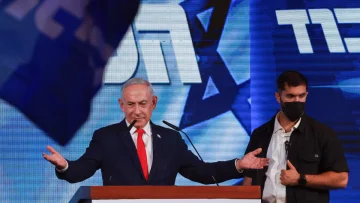
Political deadlock over forming a government in Israel has deepened, AnewZ reports. On Thursday, longtime Netanyahu ally United Torah Judaism refused to back Benjamin Netanyahu, while Arab party Ra’am supported his main rival, Gadi Eisenkot.
President Isaac Herzog was due to meet Netanyahu and opposition leader and former military chief Eisenkot at his residence in Jerusalem on Thursday evening. Herzog is considering which candidate to give the first opportunity to form a government.
No side secured the 61 seats needed for a majority in the 120-member Knesset in the October 27 election. Although Herzog’s role is largely ceremonial, he must identify the candidate with the best chance of forming a government. He must make his decision by November 11.
Netanyahu will remain caretaker prime minister until a new coalition is formed or, if efforts to form a government fail, a snap election is held.
United Torah Judaism backs neither candidate
Netanyahu’s Likud party won 27 seats in the election, performing better than expected. However, his nationalist-religious coalition lost its majority, securing just 53 seats.
United Torah Judaism, one of the two main parties representing ultra-Orthodox voters and a longtime Netanyahu ally, said on Thursday it would not endorse any candidate to form a government. “We are not tied to either bloc,” the party’s representative Yitzhak Goldknopf told Ynet.
Another party member, Yaakov Pindrus, said its position on military conscription “has not changed since the founding of the state.” According to Ynet, the party has favored legislation exempting ultra-Orthodox men from military service.
United Torah Judaism holds seven seats in the Knesset. Without its support, the number of lawmakers expected to back Netanyahu has fallen to 46. The other ultra-Orthodox party, Shas, as well as the far-right Otzma Yehudit and Religious Zionism parties, have backed Netanyahu. Shas’s seats fell from 11 to six in the election, Ynet reported.
Eisenkot has backing of 56 lawmakers after Ra’am endorsement
Eisenkot’s alliance against Netanyahu, comprising four Jewish-led parties ranging from the center-left to the right, won just 48 seats. Pre-election polls had pointed to a close race. Arab parties, meanwhile, secured a record total of 19 seats.
Like Netanyahu, Eisenkot has said he would not include Arab parties in his government. Nevertheless, Ra’am backed his candidacy on Thursday. The Joint List was also expected to take the same step later in the day.
According to the Yedioth Ahronoth newspaper, Ra’am leader Mansour Abbas and party representatives Yoav Segalovitz and Iman Khatib Yasin conveyed their support to Herzog. With Ra’am’s eight seats, the number of lawmakers recommending Eisenkot to form a government has risen to 56.
Amjad Shbita of Hadash, part of the Joint List, called Eisenkot “a coward and a racist” but did not rule out supporting him, Ynet reported. “We are ready to take any step to bring down Netanyahu’s government,” he said.
Gilad Kariv of the left-wing Democrats party said it would support an Eisenkot-led government even without a parliamentary majority. “There is a clear majority of 67 seats against Netanyahu remaining in power,” Kariv told Ynet.
Israeli President Isaac Herzog meets Hungarian President Andras Bakay, October 20, 2026. Photo: Reuters
Herzog urged political leaders to consider every option to avoid a new election and pointed to the challenges facing the country. “Any reasonable person can look at the security and diplomatic challenges we face, the changing region around us and the issues dividing us internally, and understand that we bear a great responsibility,” he said.
The president also expressed doubts about whether a minority government could function effectively. “How can you run a government that relies on a minority? It is a complex issue,” Herzog told Ynet. “The 27 seats won by Likud — the votes of a quarter of the public — cannot be ignored,” he added.
Herzog is consulting the parties from smallest to largest. His office said the approach was intended to “encourage a new way of thinking.”
Netanyahu’s election-related claims have also contributed to the political deadlock. He has cited an investigation by election officials into possible vote fraud and accused Arab parties of electoral fraud. Critics say Netanyahu and his allies are trying to discredit the results; Netanyahu denies the allegation.
Israel’s Central Elections Committee said on Wednesday that the integrity of the vote had not been compromised. The committee’s head, Supreme Court Justice Noam Sohlberg, urged elected officials to preserve public confidence in the democratic process. “This is a real danger. One of the foundations of democracy is the peaceful transfer of power,” he told Herzog. Sohlberg described high voter turnout, particularly among Arab citizens, as a positive sign.
Meanwhile, far-right National Security Minister Itamar Ben-Gvir and other Netanyahu allies have called for Arab party leaders to be arrested and questioned immediately.
With neither bloc holding a majority, analysts see three possible scenarios: a minority government, a unity government or a snap election. In the first scenario, Eisenkot could lead a minority government with support from Arab parties outside the government.
Yohanan Plesner, president of the Israel Democracy Institute, told The Jerusalem Post that such an option had “emerged as a mathematically and politically viable choice.” However, he said Israeli society was “not ready for such a government in a profound sense.”
The second scenario is a unity government that includes Likud. According to an analysis by Jim Zanotti, an analyst at the Congressional Research Service, this could involve a power-sharing deal and a rotating premiership between Netanyahu and Eisenkot. Eisenkot has previously rejected an agreement that would allow Netanyahu to remain prime minister. Plesner said a unity government could be acceptable to the public, but its political feasibility remained uncertain.
The third possibility, according to Zanotti, is a new election that could be held in early 2027. Plesner and other analysts believe another vote may be the most likely outcome. In that case, Netanyahu would remain caretaker prime minister; Plesner suggested this could ultimately benefit him most.
Eisenkot said on election night that it would be wrong to ask people to vote again after turnout had been high.
Herzog is expected to announce his choice of candidate in the coming days. The person given the mandate will have 28 days to form a coalition, with a possible 14-day extension. Zanotti also noted that the new Knesset is due to begin its work on November 10.
For Netanyahu, Israel’s longest-serving leader, the current contest is about who gets the first opportunity to form a government. With the prospect of a prolonged political deadlock in the country, failing to secure a majority could still work in Netanyahu’s favor.