OMM Newsroom

The war between Russia and Ukraine claimed more civilian lives this week as diplomatic contacts intensified ahead of peace talks planned in Abu Dhabi.
Both sides reported deadly attacks on the battlefield, AnewZ reported. International partners also discussed Ukraine’s future recovery and long-term security. As the war enters its fifth year, efforts to restart negotiations are continuing.
Russian officials said a Ukrainian drone attack in Russia’s Belgorod region killed three members of the same family, including an eight-year-old child. According to regional authorities, the drone struck a minibus carrying the victims near the Ukrainian border.
Since the war began, Belgorod has remained one of the Russian regions most frequently affected by cross-border attacks from Ukraine.
In Ukraine, the death toll from a Russian strike on a humanitarian aid distribution center in Zaporizhzhia region has risen to 40. The attack was one of the deadliest recorded against civilians this year.
The center in the village of Komyshuvakha was used to distribute aid and provide shelter to civilians. Ukrainian officials said dozens of people remained unaccounted for after the attack.
Ukrainian President Volodymyr Zelenskyy said Russian forces first dropped aerial bombs on the area and later struck an underground shelter.
Russia’s Defense Ministry said it had targeted Ukrainian military positions and denied deliberately attacking civilians.
Footage released by Ukrainian police showed the aftermath of the bombing, including destroyed buildings and rescue efforts around a large crater.
Police said several emergency service workers were killed while helping civilians. According to local authorities, at least two rescuers and four police officers died in the attack.
The strike showed that civilian infrastructure remains vulnerable to attacks even as international efforts continue to secure temporary humanitarian pauses.
Ceasefire in Oleshky enables evacuation of hundreds of civilians
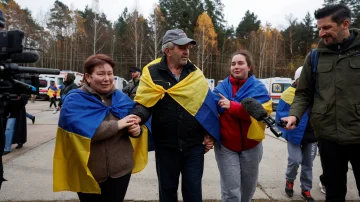
One rare positive development was reported in Oleshky, a city in southern Ukraine. A U.S.-brokered ceasefire allowed hundreds of civilians to leave the combat zone.
According to officials, a six-day ceasefire backed by U.S. first lady Melania Trump enabled about 800 people to be evacuated from territory under Russian control.
The operation was a rare example of cooperation between Russian and Ukrainian authorities and showed that limited humanitarian agreements remain possible despite the wider conflict.
Zelenskyy later awarded Melania Trump a Ukrainian state honor for her role in the initiative.
The ceasefire has expired, while fighting continues in other parts of the frontline.
Abu Dhabi talks planned for November 10-11
Attention is turning to talks planned in Abu Dhabi on November 10-11.
U.S. special envoy Steve Witkoff said Russian and Ukrainian representatives would discuss possible ways to end the war, future security measures and steps to reduce tensions.
The talks are being viewed as one of the most significant diplomatic initiatives in recent months. Pressure is mounting on both sides to explore alternatives to continued military escalation.
The Kremlin said it hoped recent political developments would not hinder U.S. President Donald Trump’s efforts to reach an agreement.
Kremlin spokesman Dmitry Peskov said Moscow was focused on the U.S. president’s “efforts to make peace.”
Zelenskyy travelled to Spain after meetings in Germany as part of a diplomatic tour aimed at securing additional military aid ahead of the talks.
The Ukrainian leader said strengthening air defenses before winter would be among the main topics in discussions with European partners.
Ukraine has warned that Russia could intensify missile and drone attacks on critical infrastructure during the colder months, increasing pressure on energy networks and civilian services.
Zelenskyy also said further consultations with U.S. officials would take place before the Abu Dhabi meeting.
While fighting continues, international partners have begun preparations for Ukraine’s future recovery.
Representatives of Ukraine, the European Union, Germany, France, Britain, the United States, NATO and the World Bank discussed recovery and future economic development this week.
The meetings covered financing mechanisms, investment tools and strategies that could support reconstruction when conditions allow.
The discussions reflected growing recognition that Ukraine’s postwar recovery will require years of international cooperation and substantial financial commitments.