OMM Newsroom

Serbian Prime Minister-designate Aleksandar Vučić has conceded that the student movement won Sunday’s parliamentary election. “It is clear that we lost this election; the ‘Student List’ has won,” he said in a televised address.
According to AnewZ, Vučić called the snap election in September. The vote took place nearly two years after student protests began over corruption and authoritarian tendencies, following the collapse of a railway station canopy in Novi Sad in 2024 that killed 16 people.
The populist and nationalist politician has held a dominant position in Serbian politics as prime minister or president since 2014.
People took to the streets of Belgrade soon after he announced his defeat to celebrate the victory. Tens of thousands gathered on the capital’s main avenues as cars honked, people danced and students shouted, “Victory” and “He is finished.”
The student movement’s victory in Serbia, a country of about six million people, is being viewed as a major shift in the country’s politics. The result recalls the defeat of Hungary’s Viktor Orbán in April. It could also serve as an example for other student movements in Europe that have protested in recent weeks over declining education standards and a lack of opportunities.
Preliminary results indicate that the “Student List” will win 135-140 seats in the 250-seat parliament, while Vučić’s Serbian Progressive Party (SNS) will take 105, Vučić said.
Radomir Sajčić, a professor at the University of Belgrade, spoke on behalf of the students at their headquarters. “Dear Serbia, tonight the people’s voice is being heard. Tonight we celebrate victory; tomorrow we build the future,” he said.
European officials and leaders, including European Commission President Ursula von der Leyen and European Commissioner for Enlargement Marta Kos, congratulated the “Student List” on its victory. Von der Leyen wrote on social media platform X: “We are ready to work together to advance Serbia’s future in the European Union.”
Hungarian Prime Minister Peter Magyar also pledged his country’s support for the students.
Voter turnout reaches record high
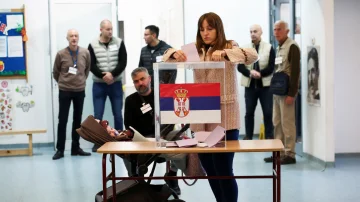
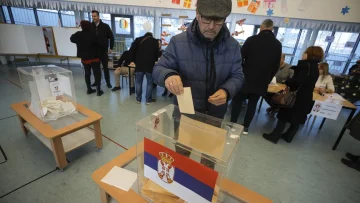
Queues formed outside polling stations in cities and towns across the country on election day. Vučić also waited about two hours to vote in Belgrade. Estimates by polling organizations and the election commission put turnout at nearly 70 percent, the highest recorded since the breakup of Yugoslavia in 1992.
Voter Katarina Petrović said of the turnout: “It did not surprise me, because a large and powerful mass has formed over the past two years.”
Vučić resigned during his second presidential term to run for prime minister again. He was regarded as a powerful incumbent, and many in the student protest movement did not believe he would concede defeat so quickly. His supporters say Vučić modernized Serbia’s economy and oversaw the construction of new highways, railways, schools and hospitals.
“Some businesspeople, some people will leave us, but our structure is strong, we are numerous and powerful, and we are used to being in opposition,” Vučić said.
Questions remain over student candidates and future policy
It remains unclear how the student-backed candidates will operate in parliament. The 250-candidate list, made up mostly of people little known to the public, includes university professors, actors and farmers. It is led by cardiologist Ilija Srdanović, who was unable to hold back tears after Vučić announced his defeat.
It is not known who will become prime minister and implement the students’ domestic policy programme, which aims to root out corruption and improve education. Political analysts predict that Vučić’s allies in the police, security services and ministries could be removed from their posts. The students have said less about their plans for foreign policy.
Like Vučić, they will have to balance relations with China, a major investor in Serbia; Russia, Serbia’s traditional ally and main natural gas supplier; and the European Union, the country’s largest trading partner.
Radivoje Grujić, an election consultant based in Warsaw, said: “The biggest uncertainty is who will lead the government, who the key ministers will be, and how they will act on promises to fight corruption, restore the rule of law and reshape Serbia’s foreign policy position.”