OMM Newsroom

Nearly 600,000 people took part in protests in cities across France on Thursday, AnewZ reported. Public-sector workers, students and pensioners protested rising living costs, stagnant wages and deteriorating public services. The demonstrations were seen as a fresh challenge to President Emmanuel Macron’s government.
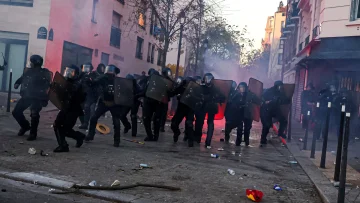
The Interior Ministry put the number of demonstrators at 575,000, while the CGT trade union, one of the main organizers, estimated turnout at 1.6 million. Protests were largely peaceful nationwide, although clashes between demonstrators and police occurred in Paris and Lyon.
Protesters voice concern over wages and public services
Participants from a range of age groups and professions said they were concerned that wages had not risen in line with inflation and about the future of public services.
Mehdi Dumontroty, a 45-year-old firefighter who joined the march in Paris, said: “Our wages have not risen in line with inflation.”
Student Alice Martinovich, 18, said she hoped young people’s concerns would be taken into account in the upcoming elections: “I hope candidates in the upcoming elections will give serious consideration to this movement and take the views of young people and students into account.”
Several prominent politicians joined the demonstrations, including potential presidential candidates Jean-Luc Mélenchon and Raphaël Glucksmann.
Clashes in Paris and Lyon, 448 arrests nationwide
Demonstrations in Paris initially had a festive atmosphere, with crowds singing the French national anthem and colorful floats taking part in the march. Tensions later rose, and police used tear gas. Similar clashes were reported in Lyon.
The Interior Ministry said 53 police officers were injured and 448 people were arrested nationwide. About 70,000 police officers were mobilized to maintain public order.
Authorities said several schools were damaged. In Toulouse, a fire broke out at a high school after a firework was set off. Education Minister Édouard Geffray condemned the incident, calling it “an absolute scandal.”
Pressure on government rises ahead of elections
The demonstrations took place five months before the presidential election, amid growing political uncertainty in France. President Emmanuel Macron cannot run for another term, adding pressure on the government to address public discontent.
Prime Minister Sébastien Lecornu is due to meet trade union and employer representatives on Monday, November 9, to discuss wages and living costs.
CGT leader Sophie Binet accused the government of trying to restrict the protests and said the demonstrations were growing. “The demonstrations are bigger than before,” she said.
As workers and students continue to demand change, France’s approach to a pivotal election period presents a new test for Macron’s government.