OMM Newsroom

Air defense systems in Gulf countries have intercepted thousands of missiles and drones. However, dwindling stocks of interceptor missiles have raised questions about how long these defenses can be sustained. New military agreements and expanded regional cooperation could help, but significant gaps remain.
AnewZ reports that explosions were again recorded in Bahrain’s skies before dawn on Sunday. The Bahrain Defense Force said several Iranian-origin aerial threats had been intercepted and destroyed before reaching their targets. This was Bahrain’s first such interception since September.
The Islamic Revolutionary Guard Corps said six drones had targeted a US air defense radar at Al-Rifaa helicopter base. The US military said it had shot down two drones without suffering damage. The extent of any damage has not been independently confirmed. It was the second attack on Bahrain in three days.
The conflict with Iran began on February 28 with US and Israeli strikes on Iran, and a ceasefire was reached in April. Diplomatic efforts have made no progress, and occasional attacks continue. Renewed threats have raised questions about the effectiveness of Gulf defenses, the potential contribution of a new joint military headquarters in Kuwait to regional security, and what Qatar could gain from its defense pact with Turkey.
Gulf defenses and interceptor stocks
Available information suggests Gulf countries’ air defenses have been operating effectively. However, the figures are based on government statements rather than independent assessments.
The United Arab Emirates (UAE) said its air defense systems had neutralized 537 ballistic missiles, 26 cruise missiles and 2,256 drones by April 8. It said 10 civilians had been killed and 224 injured during the same period. In the first weeks of the conflict, Middle East Eye estimated the interception rate at more than 92 percent. Bahrain says its defense systems have destroyed 102 missiles and 173 drones.
Despite thousands of aerial threats, the reported casualty figures suggest that layered systems comprising Patriot, Terminal High Altitude Area Defense (THAAD) and shorter-range weapons have helped protect Gulf cities.
The main challenge is sustaining defenses without exhausting costly and increasingly scarce interceptors. Analyst Kelly Grieco estimated that the UAE spends $20-$28 on defense for every dollar Iran spends on drones.
According to estimates by the Center for Strategic and International Studies (CSIS), the US stockpile of Patriot PAC-3 MSE interceptors has fallen to about 800 from more than 2,300 before the war. The assessment puts annual production at about 600 and says reaching a target of 2,000 interceptors a year before 2030 appears difficult.
According to estimates by the Jewish Institute for National Security of America (JINSA), the UAE and Bahrain, which have faced about 44 percent of the attacks, have used more than three-quarters of their PAC-3 stocks. Replenishing supplies takes time: estimates cited in the report say it takes more than two years to produce a single Patriot interceptor, while Iran can produce more than 200 Shahed drones a month.
Gulf countries do not manufacture Patriot or THAAD interceptors and compete with the United States and Israel for supplies from the same American production lines. Washington continues to approve arms sales. A $25 billion Patriot package for Kuwait, Bahrain, the UAE and Qatar was announced in May, according to reports. At the same time, one analyst expects the United States may retain more interceptors domestically to replenish its own stocks.
A Middle East analysis by the Observer Research Foundation (ORF) recommends using lasers and interceptor drones against cheaper threats while reserving Patriot and THAAD systems for more sophisticated missiles. Sunday’s attack illustrated this dilemma: even if several drones targeting a radar facility cause no physical damage, intercepting them could deplete valuable and costly defense stocks.
Kuwait headquarters and Qatar-Turkey pact
At a meeting of Gulf Cooperation Council (GCC) defense ministers in Manama on November 10, a plan was approved to establish a forward headquarters for the GCC Unified Military Command in Kuwait and assign forces to it. The command was established under a 2013 agreement, and its headquarters opened in Riyadh in 2021. Gulf leaders also called for stronger joint military cooperation at an emergency summit in Jeddah in April.
Key details of the Kuwait plan have not yet been announced. It is unclear when the headquarters will open, how many personnel will be assigned, or which military units will be stationed there. It has also not been specified whether the command will have authority to make independent military decisions or will only coordinate the activities of national forces. This could affect its effectiveness.
Gulf countries’ military systems are already based on a common technical foundation: Patriot systems form the backbone of missile defense in Saudi Arabia, the UAE, Qatar, Kuwait and Bahrain. This makes it technically possible to create a shared radar picture and agree on which country will respond to incoming threats. Sharing early-warning data and coordinating interceptor use among the GCC’s six members could help conserve dwindling stocks. If the headquarters functions mainly as a coordination center, however, its impact may be limited.
Kuwait’s selection also carries political significance. Analyst Muhannad Salum noted that Kuwait has traditionally taken a moderate stance toward Iran, but has been attacked by both Iran and Iraq. Establishing a forward military headquarters there could therefore send a broader message about Gulf security cooperation.
On November 13, Turkish President Recep Tayyip Erdogan and Qatar’s Emir Sheikh Tamim signed a mutual defense agreement in Istanbul. They pledged to take a “unified position” in the event of an external armed attack against either country. Turkey said the agreement was not directed against any particular country and suggested that other states, including Egypt, could join it.
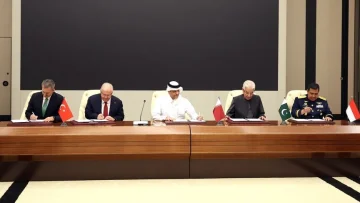
The agreement adds to a growing network of defense partnerships in the region. In August, Turkey, Pakistan and Saudi Arabia signed an agreement stipulating that an attack on one would be considered an attack on all. In October, Qatar, Indonesia, Pakistan and Turkey signed a Badr defense cooperation memorandum. These agreements give Ankara defense commitments involving both Doha and Riyadh.
Qatar’s close ties with Turkey were one of the reasons for the diplomatic boycott imposed on Doha in 2017. Relations in the region have since changed. However, the new agreement does not specify the circumstances in which military assistance would be provided or whether any forces are planned for deployment. An analyst cited by Al Jazeera said Turkish weapons and air defense systems could be deployed to Qatar in the near term. This could give Doha additional defense capabilities beyond the US supply chain.
Questions remain over whether the agreement would lead to direct military intervention. Yoel Guzansky of the Institute for National Security Studies (INSS) noted that Turkey already has a military base in Qatar. He said Iran had struck Qatar repeatedly since February, but Turkey had not responded noticeably, raising questions about how much protection additional defense agreements would provide. The key issue is whether Ankara would act if Doha came under attack again, and what form its response would take.
These three developments reflect the same challenge: Gulf countries need stronger and more sustainable defenses against threats that often cost attackers far less than they do defenders. The planned headquarters in Kuwait could improve coordination among six national armies, while the Qatar-Turkey pact could offer an additional source of military support. But these steps will not immediately resolve the shortage of interceptors.
The next indicators will be whether an opening date, leadership and assigned forces for the Kuwait headquarters are confirmed; whether Turkey deploys air defense systems to Qatar; and whether Gulf countries develop their own counter-drone capabilities while US production increases. For now, Gulf defenses have been able to repel attacks; the central question is how long they can continue to do so.