OMM Newsroom

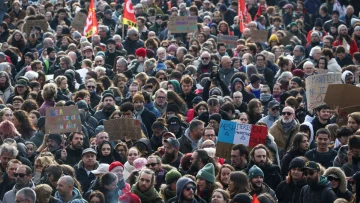
Public sector workers, students and trade unions took part in a nationwide strike and protests in France on Nov. 17. More than 200 demonstrations were held across the country, including a major march in Paris, AnewZ reported.
Months of social tension continue amid difficult budget negotiations and mounting political pressure ahead of the 2027 presidential election.
Workers seek higher wages and pensions
The latest protests reflect growing frustration over stagnant wages, rising prices and mounting pressure on household budgets. A recent survey in France found that the cost of living was the public’s biggest concern, AnewZ correspondent Ross Cullen reported from Paris.
Protesters are demanding higher wages and pensions, as well as tax cuts to ease the financial burden on families. The index used to calculate the base salaries of France’s 5.8 million public servants has been frozen for three years.
As a result, the base pay of some lower-paid public servants has fallen below the monthly minimum wage of about 1,470 euros ($1,618), excluding additional payments. Trade unions say the government’s proposals are insufficient to restore workers’ purchasing power.
The protests followed inconclusive talks between trade unions and Prime Minister Sebastien Lecornu, with the two sides unable to reach agreement on public sector pay.
Government spokesman Mathieu Lefevre defended the administration’s position. He said it had proposed salary increases of up to 650 euros before tax for more than 1.3 million public servants, alongside measures to ensure that all public employees receive at least the minimum wage.
Sophie Binet, secretary-general of the General Confederation of Labour (CGT), called the response “too little, too late,” saying the proposed increases did not match the scale of workers’ discontent.
The dispute comes as the government struggles to finalize its 2027 budget amid divisions in parliament and pressure to reduce the public deficit.
Students and school pupils join protests
Students and school pupils have been at the forefront of demonstrations since September. They initially protested staff shortages, deteriorating school buildings and a lack of educational resources.
Trade unions, public sector workers and Yellow Vest activists later joined the movement. While the government says some concerns have been addressed, students continue to call for greater investment in education and improved learning conditions.
According to France’s Ministry of Education, 3.14% of staff in the national education sector took part in Tuesday’s strike, including 3.76% of teachers. The figure among school support staff was 9.28%.
Clashes in Nantes, transport disruption in Paris
Police were on heightened alert during the demonstrations following violence at previous protests, particularly on Oct. 17. Authorities deployed a significant number of security forces to prevent a repeat of last month’s unrest, Ross Cullen reported.
Most demonstrations were peaceful, but clashes broke out in the western city of Nantes. Riot police used tear gas and water cannon against protesters.
In Paris, demonstrators marched from Place de la Nation to Place d’Italie. Metro station closures and disruptions to suburban rail services affected transport in the capital.
France’s national rail operator SNCF warned of disruptions to regional train services. High-speed TGV trains were expected to run normally.
As France approaches the 2027 presidential election, the protests are adding to the political pressure on the government. The administration is seeking to ease public discontent while securing parliamentary agreement on next year’s budget.
Far-right leader Marine Le Pen has sought to capitalize on concerns about living standards and pensions. She has promised to repeal President Emmanuel Macron’s pension reform and lower the retirement age if elected.
Talks between the government and trade unions have stalled. Demands for higher pay, stronger public services and measures to ease the impact of rising prices remain unresolved in France.