OMM Newsroom

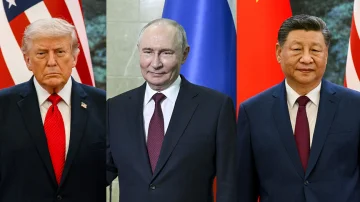
U.S. President Donald Trump, Russian President Vladimir Putin and Chinese President Xi Jinping are expected to hold a trilateral meeting on Nov. 19 in Shenzhen, China. AnewZ reports that the White House said the talks would focus on reducing nuclear weapons, with Iran also on the agenda.
The leaders could meet on the sidelines of the Asia-Pacific Economic Cooperation (APEC) summit. White House spokeswoman Olivia Wales confirmed the plans on Friday and said Trump would raise the issue of global nuclear arms reductions.
“The president has made clear that, among other topics, he will discuss reducing nuclear weapons around the world. President Trump considers their proliferation very dangerous,” Wales told reporters.
Trump is expected to arrive in Shenzhen late Wednesday and attend the two-day summit. He will also hold a separate bilateral meeting with Xi on Thursday. It would be their fourth meeting since Trump returned to office in 2025.
Wales said Trump would conclude his visit to China with a trilateral meeting involving the presidents of the United States, the People’s Republic of China and the Russian Federation. Moscow and Beijing have not officially confirmed the meeting.
Nuclear arms reductions to be a key topic of talks
The planned talks come after the New Strategic Arms Reduction Treaty between Washington and Moscow expired in February, leaving the world’s two largest nuclear powers without a key bilateral arms control agreement.
The United Nations has called for a new framework. Trump has expressed interest in reaching a broader agreement that would include China. Beijing has repeatedly rejected U.S. calls to join nuclear arms reduction talks, saying Washington and Moscow should first address their substantially larger arsenals.
According to the Stockholm International Peace Research Institute, Russia has the largest stockpile of nuclear warheads, followed by the United States and China.
A senior Trump administration official said no immediate breakthrough was expected from the upcoming discussions.
“We do not expect to reach any agreement,” the official said.
The official said the issue was difficult for China but that it was time for Beijing to take part in serious discussions on nuclear weapons, describing the meeting as the start of a conversation that could prove productive in the future.
Another senior U.S. administration official said the war between the United States and Israel and Iran could also be discussed in the trilateral talks. Russia’s war against Ukraine is not expected to be on the agenda.
“We have had numerous meetings with the Russians recently, but China is not part of that track. So it does not seem appropriate to discuss Ukraine there,” the official explained.
Trump is also not expected to hold a separate one-on-one meeting with Putin during the visit. The U.S. president’s trip will begin on Monday, when he is due to attend the ASEAN summit in the Philippines before travelling to China.
Relations among Washington, Moscow and Beijing in focus
The meeting plan was announced amid shifting relations among Washington, Moscow and Beijing. China has maintained close trade ties with Moscow since Russia launched its full-scale invasion of Ukraine in 2022. Recent U.S. decisions on Russian energy imports and sanctions have caused concern among European allies.
Trump and Xi have sought to strengthen diplomatic ties through meetings in Beijing and Washington. However, significant differences remain over trade, artificial intelligence and Taiwan.
Iran is another source of disagreement: China is Tehran’s largest trading partner and its biggest buyer of oil.
Chinese state media reported on Friday that Xi would take part in bilateral meetings on the sidelines of the APEC summit, but made no mention of trilateral talks. Earlier this month, Kremlin spokesman Dmitry Peskov said there were “signals” confirming readiness for talks at the summit.
If the meeting goes ahead as announced, the leaders of the world’s three largest nuclear powers will gather in Shenzhen to discuss arms control and other major international issues.