OMM Newsroom

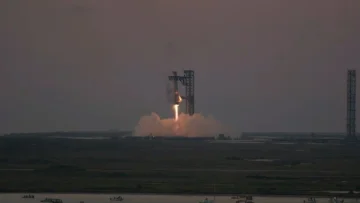
“SpaceX” will attempt to catch both parts of its “Starship” rocket after it launches on its next test flight on Friday, according to BBC World.
The company will use mechanical arms nicknamed “chopsticks” on its launch tower to catch the rocket stages as they return to Earth. A successful attempt would mark the first full recovery of a rocket that has been to space and could help make “Starship” reusable for repeated flights.
“Nasa” will closely monitor the flight because “Starship” is expected to play a key role in its “Artemis” programme, which aims to send astronauts to the Moon.
The 124-metre rocket is scheduled to lift off from the “Starbase” launch site in Texas at 16:45 local time (22:45 GMT), with a 75-minute launch window.
About six and a half minutes after launch, the first catch attempt is planned for the Super Heavy booster, the rocket’s lower stage, as it returns to the launch tower.
The upper stage, known as the Ship, will continue into space and deploy 26 satellites for the “Starlink” constellation, which provides high-speed internet from space. It is then scheduled to complete 14 orbits around Earth before returning for a second catch attempt about 22 and a half hours after launch.
“SpaceX” has caught the Super Heavy booster on three previous test flights. The upper stage, which first reached orbit in September, has not been caught by the tower arms and has instead splashed down in the ocean.
The company said it would decide whether to attempt to catch the Ship only after carefully assessing the vehicle in space. If problems are detected, there are several points in the flight at which the stage can be brought down in the ocean.
Developing a fully reusable rocket has long been an ambition for “SpaceX”. In 2015, it became the first company to land part of a rocket vertically, with its Falcon 9 booster. Falcon 9 rockets now fly more than 100 times a year, and reusing the lower stage has sharply reduced launch costs.
Professor Malcolm Macdonald, president of the Royal Aeronautical Society, said landing the entire “Starship” could take that progress further.
“A successful double catch would be visually spectacular, but full reusability has the potential to fundamentally change the economics of accessing space,” he said.
“One successful flight will not prove that model, but it could mark an important transition: from demonstrating that Starship can fly, to demonstrating how Starship could operate.”
After “SpaceX” went public earlier this year, its shareholders will be watching the flight closely, as will the US space agency. The rocket’s progress has direct implications for “Nasa”’s effort to land people on the Moon in 2028, a highly ambitious timeline.
“SpaceX” has a “Nasa” contract to configure the Ship as a lander that will eventually take astronauts to the lunar surface. “Blue Origin”, owned by technology billionaire Jeff Bezos, also has a contract to use its New Glenn rocket and lander for a Moon landing.
Both companies are also due to play key roles in “Artemis III”, currently planned for summer 2027. The mission is expected to send four astronauts aboard “Nasa”’s “Orion” spacecraft to dock with the landers developed by “SpaceX” and “Blue Origin”.
“Starship” must make substantial progress in the coming months to meet those commitments. Its development has proceeded more slowly than “SpaceX” intended.
“Blue Origin” also has work to do. Earlier this year, one of its rockets exploded, destroying its launchpad in Florida. The company had said it would return to action by the end of this year, but its return to flight has been delayed until early 2027.
“Nasa” is under pressure to meet its schedule. Administrator Jared Isaacman has said the United States is in a race with China to reach the Moon. China plans to land its astronauts on the lunar surface by 2030.