OMM Newsroom

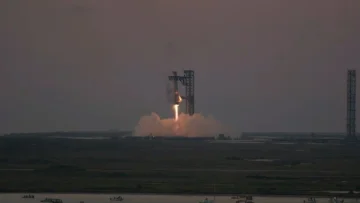
SpaceX’s 52-meter-tall Starship spacecraft returned to the company’s Starbase launch site in Texas on Saturday after a 22-hour flight in orbit, AnewZ reports. The spacecraft descended between the large mechanical arms of the tower from which it had launched. The maneuver marks a key step in the company’s goal of developing a fully reusable rocket.
Descending through thick clouds, Starship reignited its engines, moved into a vertical position and slowly lowered itself toward the tower’s arms, known as “Mechazilla,” with its engines running. Darkened by the intense heat generated during its return from space, the spacecraft remained motionless after shutting down its engines. It was the longest mission yet for the rocket system.
The Super Heavy booster, the lower stage of the two-stage rocket, carried Starship into space on Friday, November 13, from SpaceX’s Starbase facility in Texas. However, the booster failed to return to the launch pad about 10 minutes after liftoff, thwarting the company’s plan to recover both parts of the rocket for the first time.
Starship successfully returned after completing 14 orbits of Earth and flying for more than 22.5 hours. The mission marked a significant engineering milestone in the rocket’s multibillion-dollar rapid development program.
On Friday evening, Starship deployed 26 Starlink satellites while in orbit at an altitude of about 260 kilometers. On Saturday, as it traveled east over the Pacific Ocean, it fired one of its engines and began its descent through the atmosphere.
The spacecraft’s orbital speed of about 17,000 miles per hour (27,358.848 kilometers per hour) slowed as it made a supersonic freefall over SpaceX’s facilities in southern Texas, on the Gulf of Mexico coast. Elon Musk and SpaceX engineers began inspecting the spacecraft several hours after it was caught.
“Ship 42 looks great!” Musk wrote on X, sharing photos and videos taken from the launch tower.
Starship’s return marks progress toward reusable rockets
SpaceX’s position in the global launch industry rests on its Falcon 9 rocket, which has completed more than 700 flights since 2010. The rocket’s first stage is reusable, while its second stage, which carries payloads into orbit, falls into the ocean after each flight.
Musk wants Starship to become a rocket system that can travel to space and return, operate at a pace similar to commercial aircraft, and require minimal maintenance between flights.
Saturday’s recovery of Starship was a major step toward that goal, but SpaceX has yet to recover both stages of the rocket during a single mission. If achieved, it would mark the first time both parts of an orbital launch system had been recovered.