OMM Newsroom

At least 490,334 Russian soldiers have died since the war in Ukraine began in 2022, according to Russian government statistics analysed by the BBC.
The leaked data from Russia’s statistics agency, Rosstat, reveal changes in mortality patterns and the human cost of the invasion. President Vladimir Putin had expected the war to last only days, but it has now continued for four years and 10 months.
BBC Russian gained access to more than 11 million death records covering 2021 to September 2026 after a cyberattack by the Belarusian group Cyber Partisans BY and Ukraine’s Silent Crow. Rosstat acknowledged a cyberattack but denied that protected information had been leaked.
BBC Russian and independent Russian outlet “Mediazona” compared the records with their own list of confirmed military deaths, compiled from open sources since the invasion began. They found matches for 90% of the records.
The data show that 65% of Russians aged 18 to 24 who died in 2025 were killed in the war. Among those aged 25 to 34, the figure was 59%. Only for people aged 45 to 54 did cardiovascular disease claim more Russian lives than the conflict.
The records also indicate the scale of losses in specific parts of Ukraine. Around 20,000 Russian soldiers died fighting for control of 10 Ukrainian villages with a combined pre-war population of 12,000.
In the battle for Andriivka, a small village south of Bakhmut in the Donetsk region, 1,122 Russian soldiers died. Before the war, 74 people lived there.
Russia has not released public figures for its losses since the war began in February 2022. Rosstat stopped publishing data on deaths from external causes two years ago; those figures had been used to estimate military losses.
For instance, the Rosstat files accounted for only 70% of the deaths established by the BBC among soldiers from the occupied parts of Donetsk and Luhansk who fought in the Russian army.
How the estimate was calculated
The Rosstat dataset does not contain names, but it includes ages, places of residence and death, and circumstances of death.
The BBC first filtered the records by location, retaining Ukraine and Russian border regions that had experienced incursions by the Ukrainian army. It then identified 425,174 entries that explicitly indicated a military-related cause of death, such as explosions or shrapnel during combat operations.
Because that total could include civilians, women and men outside the 18-to-65 age range were excluded. People who lived and died in the four Ukrainian regions occupied by Russia were also excluded as possible civilians, unless their records included evidence of military service.
A further 14,093 entries were identified through employment information, while 51,067 people were recorded as dead following a court ruling. Such rulings are often made when a soldier has been missing in a combat zone for more than six months and their body has not been recovered. To exclude civilians, the BBC counted only deaths in war zones in Ukraine and Russia.
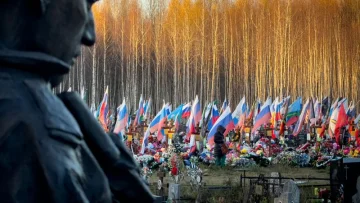
BBC Russian’s own detailed record of Russian losses stands at 290,012. The figure was verified with “Mediazona” using official reports, social media, new memorials and graves. The actual toll is likely higher because not all deaths are publicly reported.
The Rosstat data overall confirm trends found in the BBC’s own count. According to the analysis of the leaked files, the average age of Russian soldiers killed in the first year of the war was 34. By 2025, as prisoners and contract soldiers joined the ranks, it had risen to 40; the BBC’s own list puts it at 38.
Some of Russia’s poorest regions in eastern Siberia account for a disproportionately large share of the losses. Men from Tyva, Buryatia and Zabaykalsky Krai are 20 to 25 times more likely to die in the war than residents of Moscow and St Petersburg.
Across most regions, the distribution of deaths in the Rosstat data differs from the BBC’s list by only a few tenths of a percentage point.
The BBC’s analysis of the Rosstat files identified at least 5,017 foreigners among those who died fighting for Russia, including 1,031 Uzbeks and 720 Tajiks. Ukrainians were excluded to avoid counting civilians.
The estimate is conservative: people with dual nationality are listed as Russians in the database, and the files do not refer to North Koreans who died repelling Ukraine’s incursion into Russia in 2024.
The BBC identified 2,304 North Korean soldiers killed there by analysing satellite imagery and official photographs of a newly built memorial in Pyongyang.
The leaked Russian statistics may be incomplete, but the BBC said that, taken together with BBC Russian’s own work, they are significant. Military experts estimate that the BBC’s open-source figure of 290,012 may represent 45% to 55% of the actual death toll, putting it between 527,295 and 644,471.
In a war that has lasted four years and 10 months, the figures are high for Russia compared with the Soviet war in Afghanistan, which ended in 1989.
Ukrainian President Volodymyr Zelensky last put Ukraine’s losses at about 50,000 in July 2026. A separate list compiled from open sources by the anonymous website UA Losses puts the figure at 115,952.
Additional reporting by Ilya Barabanov.