OMM Newsroom

More than 720,000 Russian soldiers may have been killed since Moscow launched its full-scale invasion of Ukraine in 2022, according to an analysis based on leaked official data reported by CNN. The estimate equates to roughly one death every four minutes.
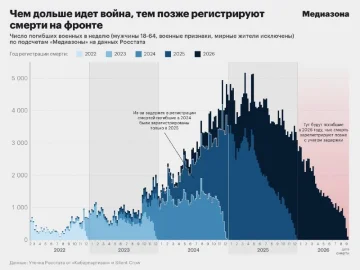
Russian opposition outlets Mediazona and Meduza reported on Monday that Russia’s statistical bureau, Rosstat, had recorded 490,000 confirmed deaths among Russian troops by the end of September. After accounting for delays in death registrations and including troops reported missing in action who are considered likely to have died, the outlets estimated the total Russian death toll at more than 720,000.
The estimated toll exceeds Russia’s losses in the Soviet war in Afghanistan in the 1980s and in both Chechen wars of the 1990s and early 2000s. The Kremlin has long sought to keep the scale of Russian military deaths secret.
Rosstat stopped publishing demographic data in 2025. Mediazona, Meduza and other outlets obtained the official data after two pro-Ukrainian hacker groups, Cyber Partisans of Belarus and Silent Crow, breached Rosstat’s servers earlier this month.
CNN said it could not independently verify the figures. However, the leaked data on confirmed deaths alone supports earlier estimates by analysts and Western intelligence, which now appear to be substantially below the likely actual toll.
Mediazona and Meduza have tracked Russian losses for years, drawing largely on inheritance records, death notices and other publicly available documents. The leaked Rosstat data enabled them to apply actuarial methods commonly used to estimate risks and insurance premiums.
By comparing reported dates of death with registration dates, and examining search notices published by relatives, the outlets estimated that around 230,000 deaths had occurred but had not yet been reported.
Mediazona’s database of troops reported missing by relatives since 2023 contains 160,000 people. The outlet said almost all were likely dead and that, based on its reporting, the survival rate among those reported missing was around 10%.
Data shared by Silent Crow showed that the war was Russia’s fourth most common cause of death since the full-scale invasion began, after heart diseases, Covid, and strokes and other vascular conditions. It also indicated that losses were unevenly distributed, with poorer areas and ethnic minorities experiencing significantly higher casualty rates.
A separate analysis by the NEST Centre, a think tank that also obtained the data, identified 6,947 records of foreign nationals killed in Ukraine. Most were from the Central Asian countries of Kazakhstan, Uzbekistan, Tajikistan, Kyrgyzstan and Turkmenistan.
Maria Pevchikh, head of investigations at Alexey Navalny’s Anti-Corruption Foundation, said the data’s release showed why Russian President Vladimir Putin was unlikely to seek a compromise to end the war.
“Putin has no way to ‘step back from public life’ or ‘focus on housing and utilities problems’ after killing 700,000 of his own citizens, and he never will. You don’t retire after something like that,” she said on X.
Alexander Baunov, a senior fellow at the Carnegie Russia Eurasia Center, said the war in Ukraine was Russia’s deadliest conflict since World War II.
“We talk a lot about the risk of nuclear escalation. But in terms of human losses, we may already be approaching the scale of a limited nuclear war,” he said.
Aby Shukiurov, a demographer and associate fellow at the NEST Centre, said Russian authorities had “made concerted efforts to conceal the demographic reality of the war.”
Shukiurov said the death toll had pushed male life expectancy in Russia down to 65.3 years in 2025, 3.1 years below the 2019 figure and close to the level recorded in 2021, the pandemic’s worst year. Female life expectancy continued to rise during the war, reaching a record 79.3 years in 2025, he said.
Ukraine, like Russia, does not release official casualty figures, although Ukrainian President Volodymyr Zelensky has publicly acknowledged the scale of combat losses. A July estimate by the Center for Strategic and International Studies put Ukraine’s casualties at between 525,000 and 625,000, including between 125,000 and 150,000 deaths.
Baunov said the combined death toll for Russia and Ukraine could exceed 1 million.
“One million dead is an important psychological threshold. But if almost nobody in Russia knows that this threshold may have been crossed, it is as if it hasn’t been crossed at all,” he said on X.