OMM Newsroom

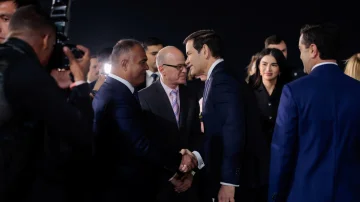
More than 200 American businesspeople have travelled to Uzbekistan alongside US Secretary of State Marco Rubio as Washington steps up efforts to turn closer ties with Central Asia into trade and investment agreements.
Rubio arrived in Samarkand on October 18. He is holding talks in the “C5+1” format with representatives of Kazakhstan, Kyrgyzstan, Tajikistan, Turkmenistan and Uzbekistan. The delegation aims to expand trade and investment cooperation with the five Central Asian republics, according to the US State Department, AnewZ reports.
The visit highlights Washington’s growing interest in the region’s critical minerals, energy resources and transport infrastructure.
Trade between US and Uzbekistan more than doubles
Trade in goods between the two countries rose from $423 million in 2024 to about $1.05 billion in 2025, according to the US Census Bureau.
US imports from Uzbekistan increased from $42 million to about $575 million. American exports to Uzbekistan grew more slowly, rising from $381 million to $474 million.
Uzbekistan had 336 enterprises operating with American capital as of December 1, 2025, according to the National Statistics Committee. Of these, 190 were registered as wholly foreign-owned enterprises and 146 as joint ventures.
More than 70 percent of the enterprises were concentrated in the capital, Tashkent, where 237 such businesses operated. Another 19 were located in Samarkand Region, where Rubio is holding talks.
Major commercial deals are also under discussion. Uzbekistan announced an $8.5 billion agreement in 2025 to purchase up to 22 Boeing 787 Dreamliner aircraft, The Diplomat reported. The publication also said that, ahead of the US-Central Asia summit in November 2025, a potential investment of up to $3 billion by Air Products in a methanol production plant was discussed.
The projects illustrate the reciprocal nature of the relationship: Uzbekistan is buying American technology and equipment, while US companies are exploring investment opportunities in the country’s economy.
US business interests across the region
Critical minerals are a major focus of Washington’s commercial interests. The Trump administration is seeking to expand access to the region’s rare-earth minerals, Reuters reported, citing a Central Asian diplomat. These materials are important for advanced manufacturing, electronics, energy technologies and defense equipment.
In June 2026, the US International Development Finance Corporation established the US-Uzbekistan Joint Investment Platform to attract investment in energy, infrastructure, critical minerals, transport and logistics.
That month, the two countries also agreed on preliminary trade commitments. Uzbekistan agreed to eliminate or reduce tariffs on some American industrial and agricultural goods, The Diplomat reported, citing the Office of the US Trade Representative. Washington, in turn, pledged to give Uzbek goods favorable consideration in future tariff decisions. The measures are intended to open markets and encourage investment in sectors of strategic importance to both countries.
China has built extensive trade and infrastructure ties across Central Asia, while Russia retains significant economic and political influence in the five republics that were once part of the Soviet Union. The United States is seeking a larger share of the region’s commercial opportunities. However, closer ties with Washington do not mean Central Asian governments intend to abandon their existing partners.
Political analyst Otabek Akromov argued in a September 2024 analysis of US policy in the region that more active American economic cooperation could give Central Asian countries additional leverage in negotiations with Moscow and Beijing. Washington’s main challenge will be turning diplomatic activity into commercially viable projects.
US investment plans extend beyond Central Asia to the South Caucasus. The $201 million Trans-Caspian Enterprise Fund covers eight countries, including Azerbaijan, Armenia, Georgia and the five Central Asian republics. The fund has identified critical minerals, energy and railway infrastructure as its main investment areas, according to Reuters.
There were 519 foreign-invested enterprises in Uzbekistan linked to Azerbaijan as of October 1, 2026, according to the National Statistics Committee. Uzbekistan has a total of 22,029 foreign-invested enterprises, and Azerbaijan is among the leading countries represented in the country’s business sector.
Azerbaijan’s strategic importance is also linked to the Middle Corridor, which connects Central Asia with Europe via the Caspian Sea, Azerbaijan, Georgia and Türkiye. As an alternative to trade routes crossing Russian territory, the corridor is playing an increasingly important role in efforts to diversify regional trade.
Akromov’s 2024 analysis identified investment in the Middle Corridor as one possible way for Washington to strengthen these connections. Azerbaijan, a key transit hub on the Caspian Sea, could benefit from expanded trade between Central Asia and European markets.
Expanding economic ties are not limited to American investment in Uzbekistan; Uzbek businesses are also increasing their presence in the United States. Uzbekistan’s AFKA is building an aluminium production facility in Kentucky, The Diplomat reported. The project is expected to create 331 jobs once completed.
Uzbekistan also established a bilateral Business and Investment Council with the United States in November 2025, The Times of Central Asia reported. The council aims to turn commercial discussions into partnerships following the “C5+1” summit hosted by US President Donald Trump.
For Central Asian governments, closer economic ties with Washington offer a chance to gain new capital, advanced technology and broader export markets without giving up long-standing relations with China and Russia. For the United States, the key measure of success will be whether diplomatic activity translates into investment, new businesses and sustainable trade.