OMM Newsroom

What is a taxpayer identification number (TIN), who needs one, how can it be obtained online, and how much does it cost? These questions are particularly relevant for individual entrepreneurs, freelancers, taxi drivers and people earning income through digital platforms.
Previously, people had to visit a tax authority to register for tax purposes. Individuals can now register electronically and receive a TIN immediately.
So, what is a TIN and how can you get one? Is it possible to apply for a TIN online? What documents are required, and how much does the service cost?
This guide answers frequently asked questions, drawing on Articles 33 and 34 of the Tax Code, and provides practical information for those seeking a TIN.
What is a TIN?
A TIN is a taxpayer identification number.
The number is assigned to each taxpayer for all taxes, including customs duties, and is uniform throughout the country (Tax Code, Article 34.6). A TIN must be stated on tax returns, contracts, invoices, cash register receipts, bank documents and other payment documents (Article 34.7).
Individuals wishing to engage in business activities must register for tax purposes.
Both individuals and legal entities use TINs. Commercial legal entities, such as limited liability companies, receive a TIN when they are registered by the state (Article 33.1), while individual entrepreneurs register with the tax authority by submitting an application.
How do you apply for a TIN?
An individual can register for tax purposes electronically or on paper. Applications cannot be sent by post (Article 34.1).
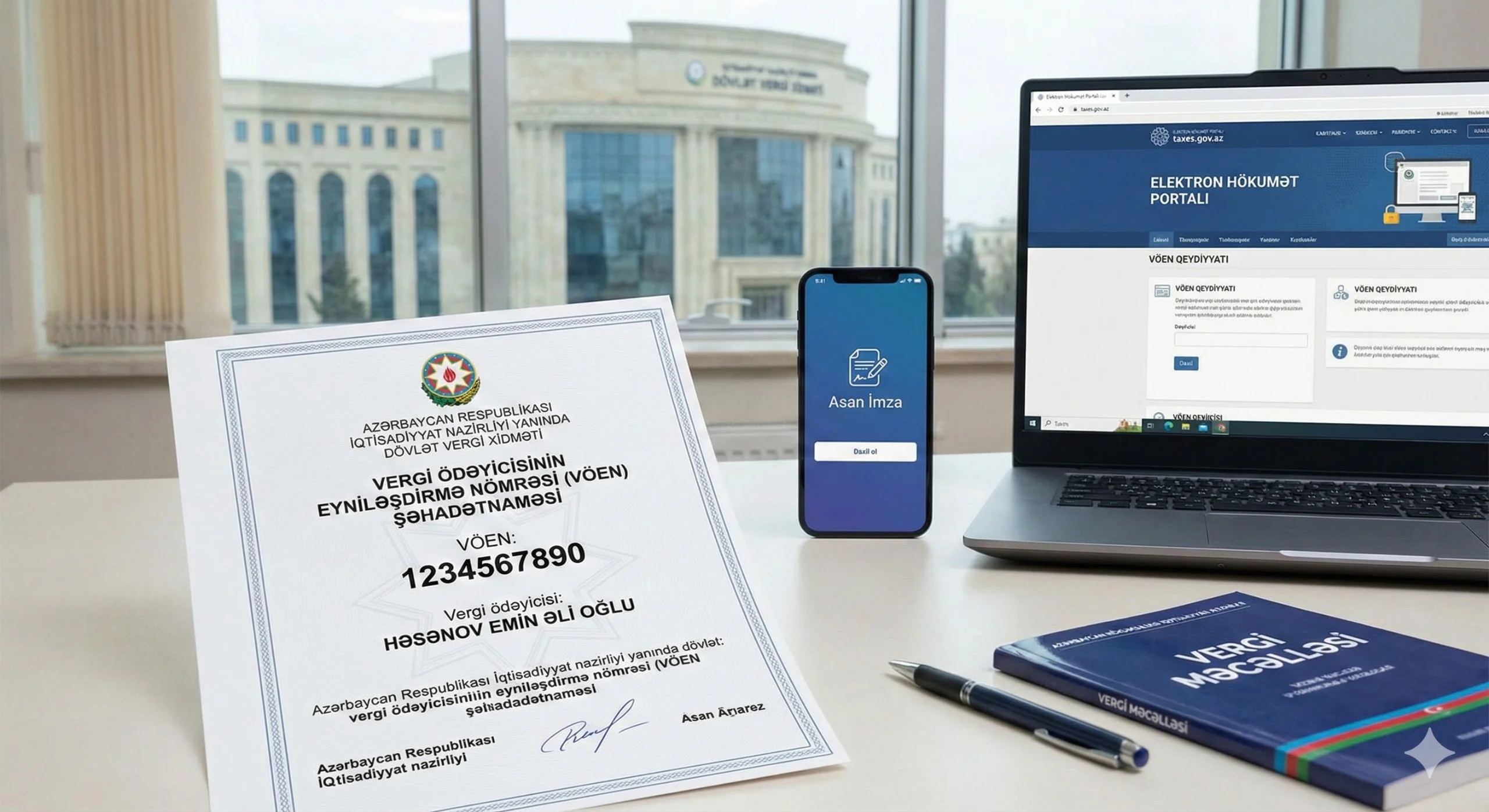
To register electronically, applicants must access the State Tax Service’s online portal using an enhanced electronic signature — ASAN İmza or SİMA İmza.
For in-person registration, applicants can contact the tax authority responsible for their place of residence (Article 33.1).
What documents are required to apply for a TIN?
An individual entrepreneur must submit an application and a copy of an identity document to register (Article 34.1).
The required documents generally include:
- an application for registration;
- a copy of an identity document;
- the relevant power of attorney if an application is submitted by a representative.
Foreign nationals and stateless persons who wish to engage in business without establishing a legal entity are registered on the basis of an identification document issued by the relevant executive authority (Article 33.3).
For online applications, the process is completed through digital identification.
Can you apply for a TIN online?
Yes. Individuals are registered for tax purposes electronically immediately, and their registration certificate is sent in real time to the electronic address created for them (Article 34.2). Paper applications are processed within one day of receipt.
Applicants can use the State Tax Service’s electronic services portal.
State Tax Service electronic portal
This means individuals do not need to visit a service center to register for tax purposes.
How to apply for a TIN online using SİMA İmza
The general steps for applying for a TIN online are as follows:
- Visit the State Tax Service’s electronic portal.
- Select SİMA İmza or ASAN İmza as your electronic identification method.
- Select the service for registering an individual for tax purposes.
- Enter the required information.
- Confirm the application electronically.
Once the electronic application is confirmed, the TIN is issued immediately and the certificate is sent to the applicant’s electronic address. The certificate can also be issued on paper if requested in the application (Article 34.2-1).
How much does it cost to get a TIN?
Registration, re-registration and deregistration for tax purposes are free of charge (Article 34.5).
However, separate costs may arise for services such as a digital signature certificate, a bank account and accounting support.
It is therefore important to distinguish between the “cost of getting a TIN” and the overall expenses of running a business.
Who needs a TIN?
An individual who wants to conduct business without establishing a legal entity must submit an application to the tax authority by the day they start operating (Article 33.4). Failure to submit the application on time carries a 200-manat financial penalty (Article 58.2). If an individual does not apply, the tax authority may register them on its own initiative and send them a notice within five days (Article 33.5).
Under the Tax Code, individuals whose income is not subject to tax withholding at source, those earning royalty income, and resident individuals earning income outside Azerbaijan must also submit an application no later than the day they become entitled to receive the income (Article 33.4).
This may apply to individuals working in a range of fields, including:
- individual entrepreneurs;
- freelancers;
- taxi drivers;
- service providers;
- people earning income from property;
- people earning income from creative work, including royalties;
- individuals engaged in other business activities.
Legal entities also have TINs as taxpayers.
Do taxi drivers need a TIN?
Tax registration is particularly important for people working in the taxi industry.
Anyone earning income by providing taxi services must formalize their activity for legal and tax purposes.
In particular, people providing taxi services through Bolt, Uber and other platforms should be aware of their tax obligations.
Taxi passenger transporters pay simplified tax, calculated as a fixed monthly amount for each vehicle rather than as a share of turnover: 9 manats multiplied by the applicable regional coefficient, which amounts to 18 manats per month in Baku (Tax Code, Articles 218.4.1, 220.5 and 220.6).
For more information, see our earlier guide:
Do freelancers need a TIN?
Freelancers should also pay attention to their tax obligations.
For example, programmers, designers, copywriters, translators and other specialists who earn income by independently providing services may need to formalize their activities for tax purposes.
A TIN allows freelancers to operate officially, enter into relevant contracts and meet their tax obligations.
This is particularly important for people working with foreign companies and through international platforms.
Does a freelancer earning income from abroad need a TIN?
Working with foreign clients does not exempt freelancers from their tax obligations.
Under the Tax Code, a resident individual earning income outside Azerbaijan must apply for tax registration no later than the day they become entitled to receive that income (Article 33.4). For example, if someone is paid by a foreign company for programming, design, translation or other services, that income must be formalized in accordance with Azerbaijani law.
People working through foreign platforms should therefore pay attention not only to the platforms’ requirements but also to Azerbaijan’s tax legislation.
What can you do after getting a TIN?
Depending on the nature of the business, a number of other steps may be required after obtaining a TIN.
These may include:
- opening a bank account for business activities;
- issuing electronic invoices;
- submitting tax returns electronically;
- paying taxes;
- using electronic services to register a POS terminal;
- accessing information about tax registration and obligations.
If the address or other information in the application changes, the tax authority must be notified within 15 days of the change (Article 34.3). Failure to comply carries a 40-manat financial penalty (Article 58.2).
It is important to note that obtaining a TIN does not automatically settle all of an entrepreneur’s tax obligations. Tax, social insurance and other obligations may apply depending on the type of activity.
Do influencers need a TIN?
People earning income through social media and digital platforms may also have tax obligations.
This is particularly relevant for influencers paid for advertising, commercial partnerships or promoting products and services.
Influencers should therefore consider tax registration and other obligations in light of the nature of their income and how they conduct their activities.
How to use SİMA İmza to apply for a TIN
To use electronic services with SİMA İmza, applicants must first have the appropriate digital signature certificate.
More information about obtaining SİMA İmza and its terms of use is available on its official website.
What does a TIN offer entrepreneurs?
One of the main benefits of a TIN is that it allows business activities to be formally registered.
Depending on the type of activity, this may enable entrepreneurs to:
- enter into official contracts;
- use a bank account;
- formalize their income;
- submit tax returns;
- issue electronic invoices;
- build an official financial record of their business activities.
A TIN is therefore not just a tax number; it is also a key element in formalizing business activities.
What should you know before applying for a TIN?
Before obtaining a TIN, entrepreneurs should determine how they plan to conduct their activities.
Getting a TIN is not the end of the process. Depending on the type of activity, taxpayers may need to select a tax regime, submit returns and meet social insurance and other obligations. A taxpayer who starts operating during the year applies the taxation method specified in the registration application (Article 218.2).
For example, the tax obligations of a taxi driver, freelancer, shop owner and influencer may differ.
It is therefore important to identify the tax regime applicable to the relevant type of activity before applying for a TIN.
Quick guide: If you want to get a TIN
Key steps to getting a TIN:
- Determine your type of activity and tax regime.
- Choose how to register for tax purposes: electronically, which is immediate, or in person at a tax authority, which takes one day.
- To apply electronically, use ASAN İmza or SİMA İmza.
- Visit the State Tax Service’s electronic portal.
- Provide the required information. Do this before starting your activity.
- After obtaining your TIN, identify the tax and other obligations that apply to your activity.
Conclusion
Tax registration is currently free for people wishing to start a business, and electronic applications are processed immediately.
It is particularly important for individual entrepreneurs, freelancers, taxi drivers and people earning income through digital platforms to clarify their TIN and tax registration requirements in advance: the application must be submitted by the day they start operating.
Most importantly, before applying for a TIN, applicants should look beyond obtaining the number and consider which tax regime applies to their activities and what obligations may arise.
Note: Tax legislation may change, so applicants are advised to consult the State Tax Service’s latest information when determining their obligations for a particular activity.
Reviewed: 14 October 2026.