OMM Newsroom

BP spent about $1.5 billion with suppliers and contractors in Azerbaijan, Georgia and Türkiye during the first nine months of 2026, AnewZ reported, citing the company’s third-quarter business update released on November 4.
The spending covered 333 suppliers and contractors and accounted for 65% of BP’s total third-party expenditure. Small and medium-sized enterprises made up the largest share of suppliers by number, while joint ventures received the biggest portion of the spending.
Of the total across the three countries, $672.6 million went to joint ventures with national partners, accounting for about 45% of the amount. Of the 333 suppliers, 227 were small and medium-sized enterprises, which received $408.3 million. Spending in the countries through foreign suppliers amounted to $360.9 million, while state-owned companies received $48.1 million.
The figures also include subcontracting costs for national labor, services and materials incurred through international contractors. As the total is reported for Azerbaijan, Georgia and Türkiye together, it cannot all be attributed to Azerbaijan; BP did not provide a country-by-country breakdown.
444 people working on Shafag project
A total of 444 people are currently working on construction of the Shafag solar power plant in Jabrayil. According to BP, about 150 of them are from Azerbaijan’s liberated territories. This means roughly one-third of the workforce comes from those areas.
By the end of September, installation of the plant’s photovoltaic modules was 50% complete. Major equipment had been delivered, while electrical installation work was continuing. The company did not say how many permanent jobs would remain after construction is completed.
At the end of September, 2,313 Azerbaijani citizens worked in BP’s operations in Azerbaijan. They made up more than 90% of the company’s professional workforce in the country.
Sangachal terminal electrification 90% complete
Infrastructure upgrades are under way at the Sangachal terminal, one of the main hubs for Azerbaijan’s oil and gas exports. According to BP’s report, the electrification project was 90% complete at the end of the third quarter, and commissioning work had begun.
Outside the terminal, upgrades to infrastructure belonging to AzerEnergy’s national electricity grid have also been completed. The project is intended to secure the terminal’s future electricity supply and strengthen its connection to the national power grid.
During the first nine months of 2026, about 138 million barrels of oil and condensate, as well as 20 billion cubic metres of Shah Deniz gas, were transported through the Sangachal terminal.
Investment in conventional energy projects continues
Despite progress on solar power and electrification projects, significant investment also went to the conventional energy sector. Capital expenditure in the Azeri-Chirag-Gunashli (ACG) fields amounted to $1.088 billion during the first nine months of 2026, while spending on Shah Deniz reached $1.078 billion. Combined investment in the two projects was about $2.17 billion.
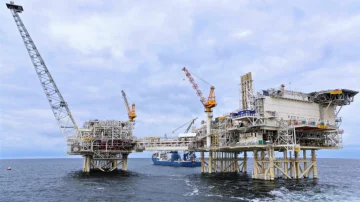
Average daily oil production at ACG was 320,000 barrels, while natural gas production at Shah Deniz was about 20 billion cubic metres. BP completed a gas expansion project at Central Azeri that increased gas reinjection capacity by 20%. Work on the Shah Deniz Compression project was ahead of schedule.
Production figures at ACG and Shah Deniz
According to BP’s report, about 4.7 billion barrels of oil have been produced since development of the ACG fields began. A total of 63 billion cubic metres of associated gas has been delivered to the Azerbaijani state.
During the first nine months of 2026, 17 wells were drilled and completed at ACG: 12 for oil production, three for water injection and two for gas injection. The company also completed its longest reservoir-contact well at the field. Drilled from the East Azeri platform, the well extends more than 2,000 metres along the reservoir.
Total production at Shah Deniz has reached about 284 billion cubic metres of natural gas and 55 million tonnes of condensate. Production from the field’s fourth well on the East North flank began in September.
BP continues to plan a well targeting the Lower Surakhani reservoir at Shafag-Asiman. At the Garabagh field, seismic data is being analyzed to support future development decisions.