OMM Newsroom
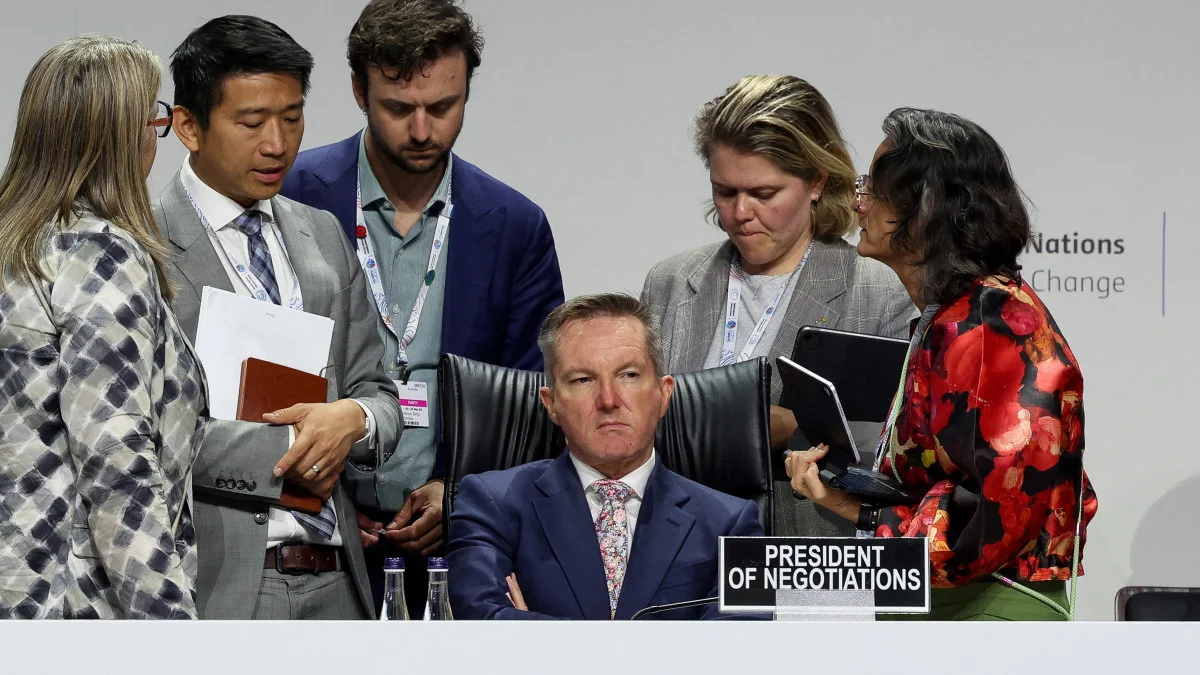
Australia’s opposition on Monday called for Climate Change and Energy Minister Chris Bowen to resign after the COP31 climate summit in Turkey ended without a political agreement, AnewZ reports. The opposition also criticized government spending and the way negotiations were conducted.
Opposition Leader Angus Taylor called on Bowen to step down. Dan Tehan, the opposition’s manager of parliamentary business, questioned Prime Minister Anthony Albanese in parliament about the reported 150 million Australian dollars ($99.23 million) spent on Australia’s participation in the conference.
Bowen, as president of the COP31 negotiations, led diplomatic efforts alongside host country Turkey to reach an agreement among about 200 countries. The summit concluded on Nov. 22 after divisions over fossil fuels and climate finance remained unresolved.
“This energy minister has to go because he has been an abject failure,” Taylor told reporters on Monday. He added: “This was Chris Bowen’s responsibility. He has to go.”
Tehan criticized the use of public funds for a conference that did not produce an agreement. He listed spending on preparatory meetings, a documentary, transport and climate advisers. “Prime Minister, how much more money does this minister have to waste before you sack him?” Tehan asked in parliament.
Albanese did not directly answer a question about whether Bowen should resign. Instead, he defended the government’s position on climate change and highlighted scientific evidence linking rising global temperatures to more severe weather events.
Albanese links failure of talks to geopolitical tensions
At a news conference, Albanese attributed the failure of the negotiations to tensions between major international powers. “It is evidence of the difficult geopolitical times in which we live,” he said.
The prime minister also pointed to Australia’s cooperation with Pacific island countries. He said climate change poses a serious risk to vulnerable communities. Albanese named Tuvalu and Kiribati among countries facing an existential threat and stressed the close link between environmental security and national security.
Albanese said Australia’s credibility in the Pacific region depended on taking real action to combat climate change.
COP31 fails to reach agreement on fossil fuels and finance
The UN climate conference opened in Antalya on Nov. 9 and concluded on Nov. 22 without a political agreement, after negotiations extended for a record period. Turkey hosted the summit, while Australia led the negotiations under an arrangement reached after a dispute between the two countries over hosting rights.
Negotiators failed to bridge differences between countries seeking stronger commitments to phase out fossil fuels and those opposed to such language. Disagreements over financial assistance for developing countries also made it difficult to reach an overall agreement.
More than 190 countries were represented at the summit, with more than 92,000 people reportedly registered. Based on initial estimates, COP31 was the largest UN climate conference in history. The United States did not send a delegation to the summit.
The outcome has increased political pressure on Bowen, but Albanese has given no indication that the minister is set to be removed from office.