OMM Newsroom

Forty-three pilot whales have died after becoming stranded on New Zealand’s North Island, the country’s Department of Conservation (DOC) said.
The pod was found on the Ngawi coast near Cape Palliser, at the island’s southern tip, shortly after 8 a.m. local time on Thursday, according to CNN.
At least 20 whales were initially known to be ashore, including four that were alive, the environmental organisation Project Jonah New Zealand said in a Facebook post on Thursday. The charity said it was working with the DOC and the local iwi, a group of Māori tribes, to assess the whales’ health and prepare to refloat the survivors at high tide.
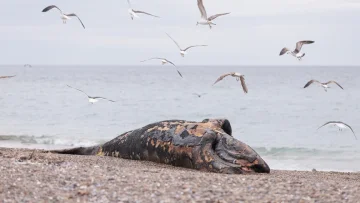
In an update on Friday afternoon local time, the DOC said 43 whales had been found along the coast from Ngawi to Mangatoetoe and that none was believed to have survived. Many were already dead when discovered, while those found alive died during the day, Project Jonah said.
“It was a difficult and distressing event for those who were involved in the response,” the charity said, thanking local people who reached the scene first and helped keep the live whales cool and as comfortable as possible.
The DOC said it was working with iwi to manage the burial of the “taonga”, or highly prized heritage. Project Jonah said the southern coast of the North Island is exposed to the powerful swells of Cook Strait. Loose gravel beaches, sharp rocks and the site’s remoteness added to the challenges facing responders.
Causes of mass strandings remain unclear
Fisherman Andrew Sim called the incident “very sad” in an interview with CNN affiliate RNZ on Thursday. He said he had spent more than four decades on the coast and had seen whale strandings before, but had never seen pilot whales come ashore there.
“It’s most strange that they’ve come in here, there’s just no reason for it, to be honest. Just bad luck, I don’t know,” Sim said.
Pilot whales are frequent stranders, the DOC says, but the causes of mass strandings are not well understood. Ian L. Boyd, a professor of biology at the University of St. Andrews in Scotland and a former chief scientific adviser at the UK’s Department of Environment, Food and Rural Affairs, said such events affect highly social species and may involve all or part of a group becoming stranded together.
Boyd said mass strandings often occur in locations with shallow, gently sloping coastlines. A social group may become disoriented and trapped by a falling tide, he said, but that is likely only part of a more complex set of causes.
The DOC says pilot whales’ social behaviour means that if one loses its way, others may come to its aid. It considers the animals’ echolocation being poorly suited to shallow, sloping waters the most likely explanation for mass strandings.
Earlier strandings in the region
It is summer in New Zealand, when whales follow common food sources inshore and most mass strandings occur. The country’s largest recorded pilot whale stranding involved an estimated 1,000 whales at the Chatham Islands in 1918, according to the DOC.
About 500 pilot whales died in mass strandings near shark-infested waters around remote New Zealand islands in 2022.
In February last year, more than 150 whales were stranded off Tasmania, Australia. All died or were euthanised; it was the first mass stranding of the animals in Tasmania in 50 years.
The year before, 28 pilot whales died after about 160 whales beached off Western Australia. Most of the pod were returned to sea.