OMM Newsroom

Renewed US strikes on Iran’s Qeshm Island have drawn attention to its strategic position near the Strait of Hormuz, reported military installations and importance to Tehran’s control of maritime traffic, Anadolu Agency reported.
US media, citing an American official, reported that the US military carried out what it described as “defensive” strikes on the island on Monday. The official said US forces targeted a surface-to-air missile launcher after Iranian forces allegedly attempted to target an American military aircraft.
The incident came more than eight months after the US and Israel launched their military offensive against Iran on Feb. 28.
Qeshm’s geography and economy
Covering about 1,500 square kilometres, Qeshm is Iran’s largest island and the largest in the Gulf. It is in the southern province of Hormozgan, near the port city of Bandar Abbas, and is separated from mainland Iran by the Khuran waterway.
The island extends along the northern Strait of Hormuz, which connects the Gulf to the Gulf of Oman. Across the waterway are Oman’s Musandam Peninsula and the northeastern coast of the United Arab Emirates.
Qeshm County, which includes Qeshm, Hengam and Larak islands, has a population of about 190,000, according to Iranian state news agency IRNA.
Fishing, maritime transportation, tourism and trade are among the area’s main economic activities. The island also has the Qeshm Free Trade Zone, commercial ports and industrial facilities that support trade with neighbouring Gulf countries.
Its UNESCO-recognised geopark, known for its geological formations and marine biodiversity, is another attraction for visitors.
Military presence and maritime control
Qeshm’s position near the Strait of Hormuz makes it important to Iran’s coastal defence and maritime surveillance. The Islamic Revolutionary Guard Corps (IRGC) Navy operates in the surrounding waters as part of Iran’s military presence along the northern side of the strait.
Iranian media have reported IRGC activities involving Qeshm and nearby islands. International media have identified a reported naval base and underground missile facilities on the island.
In May, the IRGC announced an expanded maritime control zone running from Qeshm’s western end toward the UAE’s Umm Al-Quwain, and from Iran’s Kuh Mobarak toward Fujairah. The announcement named Qeshm as a geographical reference point in Tehran’s maritime control arrangements.
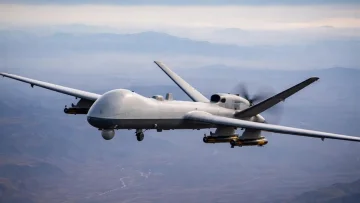
The US strikes followed an Iranian claim that its forces had downed two American reconnaissance drones south of Qeshm. The IRGC said on Monday that its forces used electronic warfare systems to bring down two MQM-170 drones, according to Iranian media. The claim could not be independently verified.
The American official was quoted as saying the strike was “a defensive measure for Iranians using surface-to-air missiles against US assets”. The location of the launcher and the extent of the damage were not immediately clear.
Earlier attacks and shipping restrictions
Qeshm has been among the Iranian islands and coastal areas targeted since the US-Israeli offensive began on Feb. 28. On May 31, US Central Command (CENTCOM) announced strikes on Iranian radar and drone command-and-control facilities on Qeshm and in Goruk on the mainland. On June 5, CENTCOM reported further strikes on coastal surveillance radar facilities in the same areas.
In March, Iranian authorities accused the US of attacking a desalination facility on Qeshm, disrupting drinking water supplies to 30 villages. Iranian Foreign Minister Abbas Araghchi condemned the attack, saying it targeted civilian infrastructure. “The US set this precedent, not Iran,” he said.
Local authorities said the facility had supplied about 40,000 residents before repairs were completed and water supplies restored. The IRGC later claimed it had targeted a US naval facility in Bahrain in retaliation.
Qeshm has gained further importance as Iran has tightened restrictions on commercial shipping through the Strait of Hormuz. The IRGC Navy has required vessels to coordinate their movements with Iranian authorities and use designated routes.
Some commercial ships have taken an alternative passage between Qeshm and Larak instead of conventional shipping lanes farther south. The passage lies in Iranian territorial waters, allowing authorities to closely monitor vessel movements. Maritime reporting has also identified an IRGC naval installation on Qeshm’s southern coast near the passage.
Iranian authorities have warned vessels against using unauthorised routes or operating without identification systems. Qeshm’s position opposite Oman and the UAE, near shipping routes serving Gulf countries, makes it strategically important to regional trade. Restrictions on routes around the island and across the wider strait can disrupt oil and gas exports and commercial shipping throughout the region.