OMM Newsroom

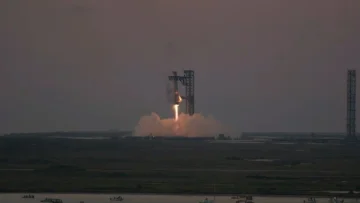
Elon Musk’s SpaceX conducted another test flight of its Starship rocket but failed to recover the giant Super Heavy booster. The 15th test flight lifted off on Friday, November 13, from the Starbase complex in Texas, United States, AnewZ reported.
The company had planned to return the booster to the launch pad and catch it with the tower’s mechanical arms, known as “chopsticks,” but abandoned the plan. The booster was directed toward the Gulf of Mexico and reportedly exploded just above the water.
SpaceX has previously caught the booster with the mechanical arms three times. The most recent such attempt took place in March 2025.
The upper stage of Starship is currently in orbit. It is expected to return to Texas on Saturday afternoon, when the company will try to catch it with the same arms. The spacecraft will make 14 orbits around Earth and land about 22.5 hours after launch.
If the catch succeeds, it will be the first time a spacecraft launched vertically has reached orbit and returned to the exact point from which it began its journey. SpaceX has described this as the first full recovery of an orbital launch system.
The company also said all 26 operational Starlink satellites aboard the spacecraft were deployed into orbit within the first two hours of the flight.
Previous test and future plans
Starship first reached orbit in September, during its previous flight. However, the mission ended early after some of its engines malfunctioned. The upper stage landed intact in the Pacific Ocean and then caught fire.
Musk has said fully reusable rockets are a way to reduce the cost of spaceflight. He expects Starship to be flying weekly by the first half of 2027.
SpaceX also plans to use the rocket to expand the Starlink network and establish artificial intelligence data centers in orbit.
NASA is also relying on Starship as a lander for its return-to-the-Moon mission. The U.S. space agency has allocated about $3.2 billion to the project since selecting the lander in 2021. SpaceX says it has spent at least $15 billion of its own funds.
A crewed landing is expected by 2028. Analysts have said, however, that unfinished tests, including transferring fuel between spacecraft in orbit, could delay that timeline.