OMM Newsroom

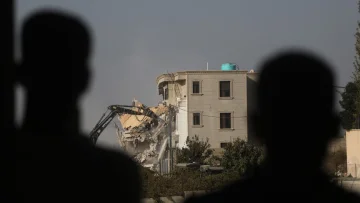
More than 2,200 Palestinians have been forced from their homes during a large-scale Israeli military offensive in Hebron, and five commercial and industrial facilities and a three-storey residential building have been demolished, the city’s mayor said.
Yousef al-Jabari told Anadolu Agency that evacuations affected Deir Bahha and parts of Al-Jilda in western Hebron. The area covers about 330 dunams (330,000 square metres) and contains more than 495 housing units.
Israeli forces surrounded Deir Bahha and Al-Jilda and used loudspeakers to order residents to leave, al-Jabari said. Some people initially refused, but troops later entered their homes and forced them out.
“Those displaced include children, women, young men and older people,” he said.
Hebron municipality said on Saturday that about 1,500 Palestinians from 250 families had been displaced. Al-Jabari later revised the figure to more than 2,200 people. He did not say where they had gone; witnesses said some families had sought refuge in other West Bank towns and villages.
In a separate count covering three neighbourhoods, Riyad Khamis, a media official with a local committee supporting affected families, told Anadolu Agency that more than 380 Palestinian families had been forced from their homes in Deir Bahha, Al-Jilda and Khirbet al-Maghariba.
The Israeli army launched the offensive on Friday after a shooting in the Farsh al-Hawa area, near the city’s northwestern entrance, killed two Israeli soldiers.
Khamis said the affected neighbourhoods form a contiguous residential area in Area A, where the Palestinian Authority is supposed to exercise civil and security control under the Oslo Accords. He said they were “located far from settlements, outposts or settler roads”.
Movement restrictions and closures in Hebron
Al-Jabari said the Israeli army had closed Hebron’s entrances, preventing Palestinians from entering or leaving. Israeli forces also closed the Ibrahimi Mosque and barred prayers as troops and military vehicles deployed across the city, he said.
The siege and restrictions on movement had left streets largely deserted, al-Jabari said, describing the measures as a “policy of collective punishment”.
He accused Israeli authorities of using Friday’s attack to step up measures against Hebron residents ahead of Tuesday’s Israeli elections. Al-Jabari said the escalation was intended to strengthen support for the far right among occupiers.
After Friday’s attack, Prime Minister Benjamin Netanyahu threatened a wider military operation in the occupied West Bank, which he described as unprecedented since the 1967 war. He said it would include evacuating Palestinian neighbourhoods and raiding homes.
The siege has forced hundreds of businesses in Hebron and nearby villages to close because workers cannot reach their workplaces and goods cannot be transported in or out, al-Jabari said.
“Israeli forces have continued demolishing commercial and industrial facilities and residential buildings since Friday,” he added.
Al-Jabari said the municipality had declared a state of emergency in the area and sent teams to assist displaced residents. “Municipal teams are working to secure shelter for displaced families, assess residents’ needs and address damage to roads, water networks and sewage infrastructure,” he said.
The offensive comes amid a rise in Israeli army and settler attacks across the occupied West Bank, including East Jerusalem, since Israel began its war on Gaza in October 2023. The attacks have included killings, arrests, the demolition of homes and other structures, destruction of agricultural land, displacement of Palestinian communities and settlement expansion.