OMM Newsroom

Lahore, the capital of Pakistan’s eastern Punjab province, has topped the ranking of the world’s most polluted major cities as hazardous smog blankets the region.
According to AnewZ, the city’s Air Quality Index (AQI) stood at 358 on the evening of Wednesday, November 11. By Thursday morning, AQI readings in several Punjab cities had exceeded 500.
The pollution has reduced visibility, disrupted road traffic and raised concerns about the health effects of prolonged exposure to polluted air.
According to an assessment by the Pakistan Air Quality Initiative (PAQI), Lahore’s average concentration of PM2.5 particles from October 1 to November 9 was 126 micrograms per cubic meter. That is about eight times the World Health Organization’s annual guideline of 5 micrograms per cubic meter.
The study found that Pakistan’s 24-hour national air quality standard was exceeded on all 40 days for which reliable measurements were available. Fine particles known as PM2.5 can penetrate deep into the lungs and may be linked to respiratory and cardiovascular diseases.
Pollution sources include vehicle emissions, the burning of crop residue and waste, as well as industrial activity. According to the Punjab Urban Unit’s 2020-21 emissions inventory, transport accounted for 35% of PM2.5 emissions in Lahore, crop-residue burning for 33%, waste burning for 29% and industry for 3%.
Satellite instruments recorded 18,825 fires across Punjab from October 1 to November 9. About 89% of them — 16,714 — were classified as probable crop-residue fires.
Cool weather, light winds and a low atmospheric mixing layer limit the dispersal of pollutants, causing them to accumulate near the ground. Punjab officials have also cited pollution crossing the border from India. However, PAQI’s analysis said there was insufficient evidence to attribute Lahore’s pollution after the Diwali festival solely to fireworks.
The Punjab Environmental Protection Agency said 679 incidents related to agricultural fires had been recorded, of which 650 had been extinguished. Drones, night patrols and rapid-response teams have been deployed to detect and tackle fires.
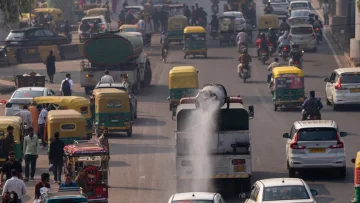
Anti-smog devices and water-spraying operations are also being used along designated routes. However, their impact remains limited unless pollution sources are reduced.
Long-term measures are being implemented under Punjab’s Clean Air Program. Supported by a $300 million World Bank loan, the program aims to cut PM2.5 levels by 35% over the next decade. Measures include deploying 5,000 super seeders to manage crop residue and introducing 600 electric buses.
The smog that returns to Lahore every winter cannot be tackled through emergency measures alone. Improving air quality requires sustained emissions cuts in the transport, agriculture, industry and waste sectors.