OMM Newsroom

Iran has unveiled a new underground missile and drone base. Amid reports of oil tankers striking sea mines in the Strait of Hormuz and ongoing tensions with the United States, Tehran said it would respond forcefully to any potential attack.
According to AnewZ, Iranian Parliament Speaker Mohammad Bagher Ghalibaf praised the inauguration of the Islamic Revolutionary Guard Corps (IRGC) facility. He said it was a clear warning to the country’s rivals that, if Tehran were attacked, it would “determine the geography of any military confrontation.”
“Do not miscalculate. If you do, Iran will not hesitate to defend itself swiftly and on a scale far greater than you imagine,” Ghalibaf said. He is Iran’s chief negotiator in peace talks with the United States.
In a message marking the unveiling, Ghalibaf said the facility, described as a “missile city,” was part of efforts to build sustainable deterrence through preparedness for defense, continued progress and national unity.
Iran displays underground missile capabilities
The IRGC unveiled the underground missile and drone facility on Tuesday but did not disclose its location.
Speaking at the unveiling, IRGC Aerospace Force commander Brigadier General Majid Mousavi said: “If necessary, Iran will disable all the capabilities of its enemies in the region and beyond.”
Mousavi said Iranian missiles would drive the country’s enemies to defeat and humiliation. “We will demonstrate our strength, endurance and determination to our enemies and deter them from any miscalculation,” he said.
Iran’s extensive missile program includes domestically produced one-way attack and loitering combat drones, cruise missiles and ballistic missiles with ranges of up to 2,000 kilometers.
Tehran used these weapons in conflicts with Israel and the United States in 2025 and 2026, launching missile strikes against Israel as well as U.S. military bases and interests in the region.
Iran has built extensive underground missile facilities in various parts of the country to protect its arsenal. Previously released footage showed some of the complexes’ interiors. New footage shows senior Iranian military officials and IRGC commanders touring the base in a military jeep.
Missile production moved underground
Tehran has also stepped up efforts to protect military production facilities from future attacks. After missile production lines and factories were hit during the 12-day war in June 2025 and the 40-day conflict in 2026, Iran moved production facilities underground to make them less vulnerable to attack.
IRGC spokesman Hossein Mohebbi confirmed the move at a press briefing on Saturday marking Iran’s Aerospace Week. He also said the Guards would no longer limit the range of their ballistic missiles to 2,000 kilometers.
The previous restriction had been imposed by former Supreme Leader Ayatollah Ali Khamenei, who was killed in joint Israeli-U.S. airstrikes in late February 2026.
Iran’s ballistic missile capabilities and civilian nuclear program remain key points of disagreement in talks with Washington. Both issues were at the heart of tensions before the military confrontation in the Strait of Hormuz, while mediation efforts have made little progress toward resolving them.
IRGC says tankers have exploded in the Strait of Hormuz
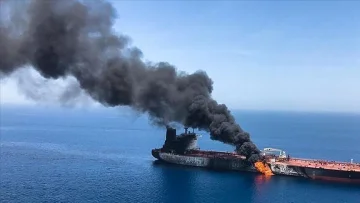
The unveiling came amid continued tensions in the Strait of Hormuz. The IRGC reported several more explosions involving oil tankers attempting to pass through the strategic waterway.
According to a statement issued by the IRGC Navy late Tuesday, another tanker struck a sea mine and exploded while attempting to cross the strait along an unauthorized route.
“After the radar and coastal navigation systems of the U.S. ‘army of smugglers’ were destroyed in the southern part of the Strait of Hormuz, tankers violating the rules have tried to use an illegal route, taking many times greater risks than before,” the IRGC statement, published by Sepah News, said.
On Wednesday, the organization reported that two more tankers had exploded, alleging that the vessels had tried to secretly leave the strait with support from U.S. military personnel.
According to the IRGC, the tankers struck sea mines and were hit by powerful explosions “while secretly attempting to leave the unauthorized and dangerous route of the Strait of Hormuz with the support of fighter jets from the predatory and aggressive U.S. military.”
The IRGC Navy alleged that the vessels had switched off their navigation and identification systems and tried to pass through the strait on the orders of a U.S. military officer.
“The sea mines stopped these smugglers and added another page to the blacklist of CENTCOM’s terrorist commander, Brad Cooper,” the statement said.
The statement also said: “There is no need for criminal and desperate U.S. military personnel to stage a media show from a helicopter outside the Strait of Hormuz to prove their lies. Aerial photographs of the strait show everything without censorship.” The remark referred to Cooper’s October 25 visit to the strait aboard a U.S. Army CH-47 Chinook helicopter.