OMM Newsroom
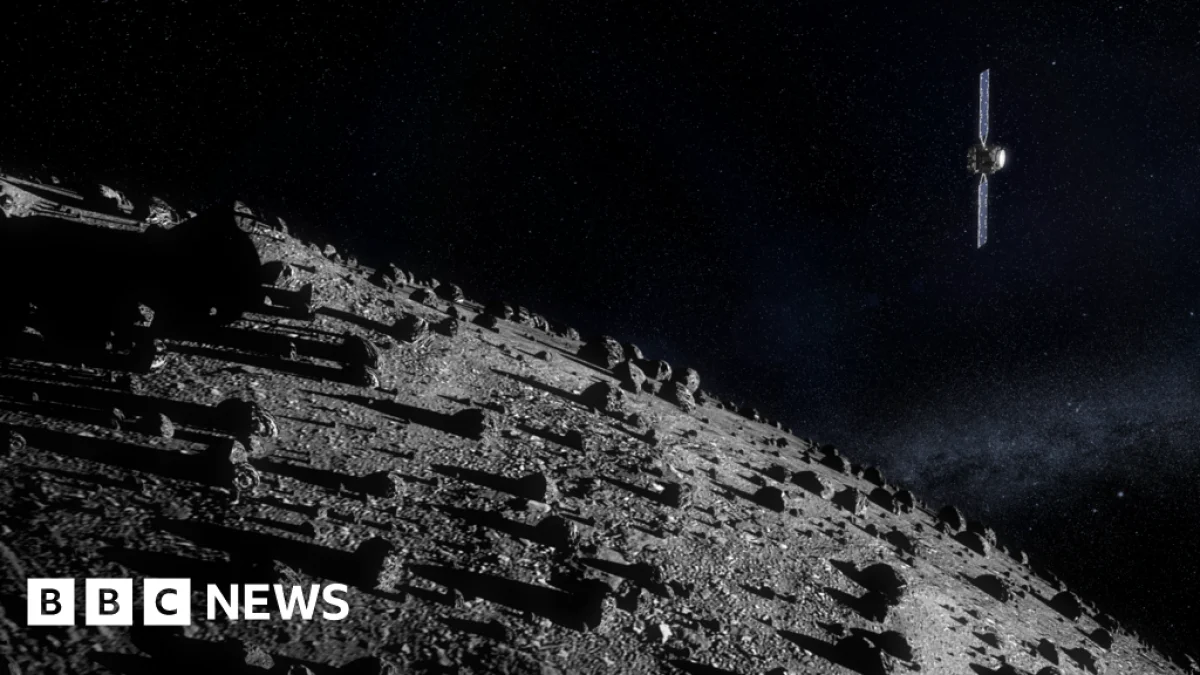
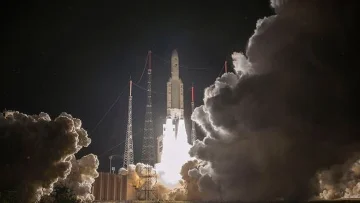
A spacecraft has reached an asteroid to investigate the aftermath of a collision designed to test planetary defence. The European Space Agency’s Hera mission is examining Dimorphos, which NASA’s DART spacecraft deliberately struck in 2022, BBC World reported.
DART was destroyed on impact. Hera has arrived four years later to assess the damage, with the mission’s first images due to be released later on Wednesday.
The asteroid poses no threat to Earth. The collision was the first test of whether a spacecraft could change the course of a space rock that might otherwise be heading towards the planet.
“Hera is a sort of Inspector Columbo going back to the crash scene to investigate what is the outcome of this impact,” said Patrick Michel, principal investigator of the ESA mission.
The test involved two asteroids: Didymos, about 730 metres (2,400 feet) wide, and its smaller orbiting companion, Dimorphos, about 150 metres (490 feet) wide.
DART hit Dimorphos at 22,000 kilometres per hour (14,000 miles per hour). Images showed the asteroid’s rocky surface approaching until the video feed cut out at impact. A debris trail about 10,000 kilometres (6,200 miles) long was later observed by telescopes on Earth and in space.
The collision demonstrated that the smaller asteroid’s path could be changed. Before impact, Dimorphos took 11 hours and 55 minutes to orbit Didymos. After the collision, its orbital period was about 33 minutes shorter.
Hera’s arrival will help scientists answer questions about the collision’s effects. “Dart exploded in the asteroid, and therefore we don’t have the information of what is its final state,” Michel said.
The impact may have created a crater, whose size and depth scientists need to determine, or it may have reshaped the asteroid entirely, he said.
Hera will spend the next year studying Dimorphos and will also examine Didymos. The spacecraft carries scientific instruments and two small, shoebox-sized satellites that can inspect the impact site at close range and later land on the asteroid.
One of the mission’s main tasks is to measure Dimorphos’s mass, which will help scientists determine how effective the spacecraft’s impact was.
“It would help us to predict what would happen if we had to hit another asteroid,” said Simon Green, a planetary scientist on Hera’s science team. Measuring an asteroid’s properties could help scientists calculate the spacecraft mass, speed and timing needed to deflect it enough to miss Earth, he said.
Asteroids pose a significant threat to Earth. Objects more than a kilometre across could cause global devastation, while medium-sized asteroids about the size of Dimorphos could destroy a city.
“We all know what happened to the dinosaurs, right? And we don’t want that to happen to us,” said Carolyn Ernst of the Johns Hopkins Applied Physics Laboratory, who works on both the DART and Hera missions.
Ernst said there are far fewer potential threats in the Solar System than there were millions of years ago, but objects remain. The largest asteroids have been identified and none are heading towards Earth, she said. The smallest pose less of a threat because Earth’s atmosphere protects the planet, while some objects in the middle size range remain undiscovered and could cause problems if they struck.
A space telescope called the Near-Earth Object (NEO) Surveyor is scheduled to launch in 2027 to track potentially hazardous asteroids.
Further asteroid visits are also planned, including to Apophis, which is about 450 metres (1,480 feet) long. Discovered in 2004, it was initially thought it might hit Earth as early as 13 April 2029.
Scientists now understand Apophis’s orbit better and say it will not hit Earth for at least the next 100 years. Instead, it is expected to pass about 32,000 kilometres (20,000 miles) above the planet’s surface in 2029, giving scientists a rare opportunity to study it up close.
Two spacecraft are due to travel to Apophis: NASA’s OSIRIS-APEX, which previously collected a sample from the asteroid Bennu, and Ramses, a joint mission between the ESA and the Japan Aerospace Exploration Agency (JAXA).