OMM Newsroom
European leaders have said they are ready to negotiate with Russia on ending the war in Ukraine, in a show of support for Kyiv, according to BBC World.
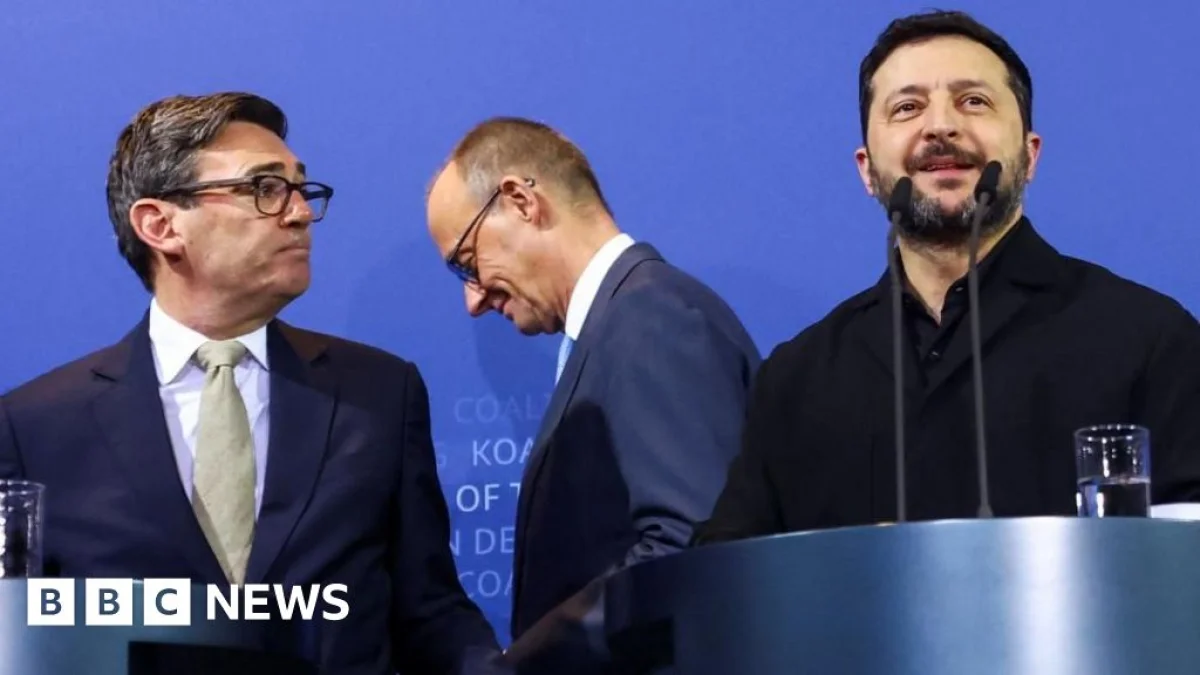
Speaking at a Berlin summit of Ukraine’s allies, known as the Coalition of the Willing, UK Prime Minister Andy Burnham said Europe had a “clear and consistent and united negotiating position”. German Chancellor Friedrich Merz said Moscow’s “maximalist demands are not realistic”.
US President Donald Trump’s envoys also attended the summit. His son-in-law, Jared Kushner, said Trump wanted to reach a deal with Russia “with Europe by his side”. Russian President Vladimir Putin has so far rejected a European role in the US-led peace talks.
Trump had earlier held trilateral talks in Shenzhen with Putin and Chinese President Xi Jinping, then joined the Berlin summit by phone from Air Force One.
Putin says Russia wants to clarify Europe’s position
At a lengthy news conference after meeting Trump and Xi, Putin said the Americans were “insistently” asking Russia to let Europeans take part in multilateral peace talks. He said Russia was not opposed to the idea, but wanted to clarify “what Europe will bring to these talks”.
“That is why, through diplomatic channels, we have invited the Europeans to come to Moscow in order to determine their positions. And after that, we will decide in what format we will continue the dialogue with Ukraine,” Putin said.
Putin also said Russia heard “every day” that European leaders were talking about a war coming in 2030. “But we are not planning to attack anyone... Is that normal? I do not think so,” he said. He added that Russia understood that “discussing issues linked to security in Europe is pointless without the Europeans”.
Kushner told reporters that Trump had left the Shenzhen meeting believing “peace is achievable”. He said Russia was willing to trust the US envoys’ view that Europe should be at the negotiating table, and that Moscow was now “comfortable” with security guarantees for Ukraine based on the principle in NATO’s Article Five, which requires allies to come to a member country’s defence if it is attacked.
Ukrainian President Volodymyr Zelensky has long sought a guarantee equivalent to NATO’s collective defence clause. There has been little indication that Putin would accept such a condition. Russia has never accepted the idea of Ukraine joining NATO, although Article Five-style guarantees could theoretically be offered to Kyiv without it becoming part of the alliance.
European leaders call for acceptable terms
Zelensky, Merz, Burnham and French President Emmanuel Macron struck a more cautious tone than Kushner. Zelensky said the Russian president had rejected every proposal so far: “Putin has always said no.”
Merz was also sceptical, although he said the prospect of peace was improving with US involvement. Europe was willing to hold “serious discussions on European security” with Russia, he said, “as long as it’s matched with a serious discussion and only first a peace agreement with Ukraine”.
“These talks have to begin, and we will accept if conditions are acceptable for Europe and Ukraine,” Merz said.
Moscow has sent mixed signals about European participation. After a visit to Moscow last week, US envoys Steve Witkoff and Kushner appeared certain that Europe would soon have a place at the negotiating table. But Kremlin aide Yury Ushakov said this week that a “great deal” needed to be done before the format could be expanded, suggesting several more rounds of discussions would be needed before four-sided talks could take place.
Russia launched its full-scale invasion of Ukraine in February 2022. Although Russia has taken part in several rounds of talks over the past year, little in Moscow’s statements or actions suggests the Kremlin is considering reducing its war effort.
Russia continues to strike Kyiv’s energy infrastructure as winter takes hold. Civilian casualties are increasing across the country, while Kremlin officials have not moved from Russia’s demands concerning Ukrainian sovereign territory.
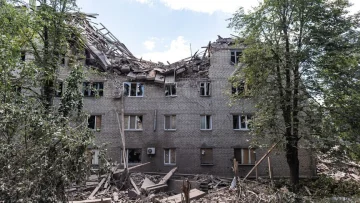
On Thursday, as delegations met in China and Germany, drones struck several buildings in Kyiv’s historic centre. One person was killed in an attack on a residential building in the Podilskyi neighbourhood. The Dutch and Austrian embassies, as well as Saint Volodymyr’s Cathedral, reported damage.
Putin also vowed that Moscow’s response to a Ukrainian strike on the Crimean Bridge, which links Russia with occupied Crimea, would be “considerably more painful” than what Kyiv had achieved.
He said he had discussed a “possible ceasefire in a number of areas” but decided against it after the attack on the bridge. Putin said he was “interested” in ending the war and ready to make compromises, while claiming Ukraine and Europe were not.
“I assure you, we have no desire at all to continue this armed conflict,” Putin said.