OMM Newsroom

German Chancellor Friedrich Merz told the Bundestag that “Russia wants more than Ukraine.” His warning comes as governments on NATO’s eastern flank grow increasingly concerned that the war in Ukraine could escalate into a wider confrontation in Europe.
Merz has called for higher German defense spending and continued support for Kyiv, saying Russia is raising tensions in the Baltic region, Poland, the Black Sea, space and Germany itself, AnewZ reports.
European governments’ security concerns beyond their borders have intensified following a series of incidents over the past week.
Incidents around Poland
In Poland, one of Ukraine’s key military and political backers, officials said three Russian Kh-101 missiles entered the country’s territory and crashed last week. The incident prompted an emergency response and renewed debate over how the alliance should react when Russian weapons enter NATO territory.
Prosecutors later said an initial analysis indicated that the missiles had been manufactured in Russia in late 2026. Separately, Warsaw described a brief incursion by a surveillance drone into Polish airspace, followed by a change in its course, as a deliberate Russian violation of its airspace.
Polish Deputy Defense Minister Pawel Zalewski said it was difficult to believe the incident was accidental. In comments to Polish media, he said it was hard to imagine it had happened by chance and that they believed it was deliberate.
The incidents have heightened fears that the war could trigger a wider crisis, not through a deliberate attack but through miscalculation or escalation. NATO has confirmed it will send an AWACS early-warning aircraft to Poland to strengthen surveillance on the alliance’s eastern flank.
NATO Secretary-General Mark Rutte stressed that the alliance was monitoring the situation closely, saying: “We will always make sure that we defend every inch of NATO territory.”
Tensions in the Baltics and concerns over Kaliningrad
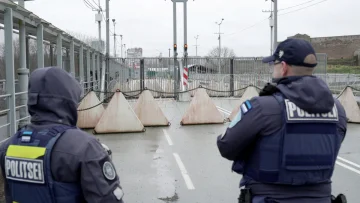
Further north, relations between Russia and Estonia have deteriorated sharply. Citing security concerns, Estonia announced it would close land border crossings with Russia for at least six months and accused Russian services of involvement in hostile activities on Estonian territory.
Russia’s Foreign Ministry accused Estonia of a series of hostile actions and said Tallinn’s policies were “on the verge of provoking an open war.” Moscow’s allegations include claims that Estonia is facilitating Ukraine’s military activities and obstructing Russian interests in the Baltic region. Estonian officials have rejected the accusations, calling them disinformation.
As Estonia is a NATO member, any direct confrontation between the two countries could affect all members of the alliance. Tallinn resident Liisi Rohtung said Russia had repeatedly tried to put pressure on neighboring countries since its attack on Ukraine, adding: “People have to endure.”
Much of the concern centers on Kaliningrad, Russia’s heavily militarized exclave between Poland and Lithuania. It hosts assets of the Russian navy, missile forces and air defense systems, making it one of Europe’s most strategically sensitive locations.
Recent events have highlighted the exclave’s vulnerability. A Russian cargo ship linked to military logistics was damaged in the Baltic Sea after a drone attack. Local authorities in Kaliningrad have also reported warnings about drones and rising security concerns.
Moscow has announced plans to build two large rail ferries to ensure supplies to the territory. Russian Prime Minister Mikhail Mishustin said the project was necessary, adding that actions by other countries that Russia describes as hostile were making logistics to the exclave more difficult.
Security analysts consider Kaliningrad one of the most likely places for a future crisis between Russia and NATO to emerge. An attempt by Russia to strengthen its military presence there, or Moscow’s belief that NATO was seeking to isolate the exclave, could quickly escalate tensions. The Kremlin has said it would take serious measures if Russia’s land links to Kaliningrad were threatened.
Europe’s security approach is changing
The rise in incidents is one reason European governments are increasing defense spending at a pace unseen in decades. Germany plans to more than double its defense spending by 2030. Poland has become one of NATO’s highest military spenders relative to the size of its economy.
In his parliamentary address, Merz said support for Ukraine was not just assistance to Kyiv: “By supporting Ukraine, we are also protecting ourselves.” This widely shared view among European leaders holds that Ukraine is the first line of defense against broader instability on the continent.
Russia denies claims that it is seeking a confrontation with NATO. The Kremlin has repeatedly said Moscow’s actions are driven by national security concerns and that it has no intention of attacking alliance members.
Moscow has also denied responsibility for many incidents attributed to it by European governments, including allegations of sabotage, cyberattacks and interference operations. Russian officials argue that NATO expansion, increased military deployments and support for Ukraine have contributed to rising tensions.
For much of the war, European leaders have presented the conflict primarily as a struggle within Ukraine’s borders. Missiles landing in Poland, rising tensions with Estonia, concerns over Kaliningrad and NATO’s expanding military activity are making that approach harder to sustain.
Merz’s warning reflects this shift in Europe’s security debate. European governments now face not only the question of how to help Ukraine resist Russia, but also whether a broader confrontation is emerging, with a front line stretching from the Black Sea to the Baltic, from cyberspace to NATO’s borders.
For now, the incidents remain limited in scale. However, many European capitals are finding it increasingly difficult to view them as isolated events.