OMM Newsroom

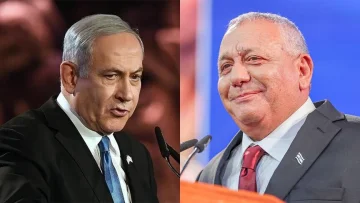
Israeli Prime Minister-designate Gadi Eisenkot plans to inform President Isaac Herzog next week that he has formed a government, the Walla news website reported Tuesday, according to Anadolu Agency.
Eisenkot, leader of the Yashar party, intends to conclude negotiations with caretaker Prime Minister Benjamin Netanyahu’s Likud and ultra-Orthodox parties by the end of this week, Walla said.
If the talks fail, Eisenkot plans to proceed with a government that would rely on outside support from Arab parties. He would not seek an extension of his mandate, according to the report. Eisenkot did not comment.
His initial 28-day mandate to form a government expires on Dec. 6 and may be extended by a further 14 days.
Under Israel’s Basic Law, notifying the president that a government has been formed does not automatically bring it into office. The proposed Cabinet, its program and the allocation of ministerial portfolios must be presented to the Knesset for a confidence vote at a session held within seven days of parliament being notified.
Plan to proceed without an extension
Walla reported that Eisenkot is determined to remove Netanyahu from office and form a government even if negotiations with Likud and the ultra-Orthodox parties fail.
The website said the delay in announcing a government is largely due to Eisenkot’s efforts to accommodate two of his main partners. Former Prime Minister Naftali Bennett wants all options for a national unity government with Likud to be exhausted, while Yisrael Beiteinu leader Avigdor Lieberman wants to explore bringing ultra-Orthodox parties into the coalition.
“Eisenkot’s camp aims to conclude talks on both tracks by the end of this week, with the intention of informing the president, possibly at the beginning of next week, that he has succeeded in forming a government,” Walla said.
The timetable could shift by a day or two, but this is the course being pursued by Eisenkot’s Change Bloc, which has decided not to prolong negotiations unnecessarily or ask Herzog for an extension, the website added.
Arab parties could provide outside support
If negotiations with Likud and the ultra-Orthodox parties fail, Eisenkot intends to form a minority government made up of Change Bloc parties and rely on outside support from Arab parties in the Knesset confidence vote, Walla reported.
The Change Bloc consists of Eisenkot’s Yashar party, Bennett’s Together party, Lieberman’s Yisrael Beiteinu and the Democrats, led by Yair Golan. The four parties hold 48 seats in the 120-member Knesset.
The Joint List and the United Arab List, also known as Ra’am, hold 19 seats between them. Support from their lawmakers would give an Eisenkot-led government backing from 67 members.
Walla said Eisenkot would consider his campaign pledge not to rely on Arab parties fulfilled as long as they were not coalition partners or members of the government itself.
“If Arab Knesset members choose to vote in favor of forming this government, Eisenkot will make clear that this is their decision alone,” the website said.
Walla reported that the Joint List had already indicated it intended to help replace Netanyahu’s government. Ra’am leader Mansour Abbas, meanwhile, sought to reassure party members, saying: “It is possible to bridge the gaps and form a stable government.”
Arab parties are seeking to prevent Netanyahu from forming another government or forcing another election that could allow him to remain in office until a new government is eventually formed. They do not see an Eisenkot-led government as their preferred option, but regard the political choice as one between two unfavorable alternatives, according to the report.
Coalition talks remain inconclusive
Eisenkot has been holding coalition talks since Herzog tasked him with forming a government on Nov. 8, but no significant breakthrough has been publicly announced.
His four-party bloc falls short of the 61 seats needed for an outright majority in the Knesset, leaving him dependent on support from additional parties to secure parliamentary approval.
His allies also disagree over which parties should join the coalition. Bennett favors a unity government with Netanyahu’s Likud, while Lieberman is pushing for an alliance with ultra-Orthodox parties. Golan opposes Netanyahu joining the government and favors forming one with outside support from Arab parties.
If Eisenkot’s government wins the Knesset confidence vote, it would formally take office and its prime minister and ministers would be sworn in, ending Netanyahu’s caretaker government.