OMM Newsroom

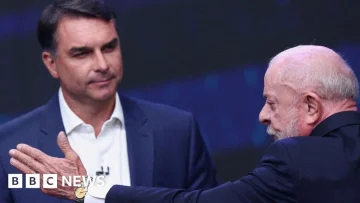
Brazilians return to the polls on Sunday to choose between President Luiz Inácio Lula da Silva and Flávio Bolsonaro, in a runoff shaped by concerns about crime, corruption and a broader rightward shift among voters in Latin America. The two candidates are campaigning on sharply different visions for the country, according to “CNN”.
Lula, 80, entered the election as the polling favorite, seeking a fourth term and to extend a political career that has shaped Brazil for more than two decades. Instead, he faces Flávio Bolsonaro, 45, the eldest son of former President Jair Bolsonaro, whose stronger-than-expected first-round performance upended predictions and left Lula the underdog.
The vote will have implications beyond Brazil. With right-wing governments gaining ground across Latin America, the result could determine whether the region’s largest country becomes an ally of the Trump administration. Flávio is seeking to do what his father could not in 2022: defeat Lula at the ballot box.
Crime and economic concerns shape the campaign
Brazil’s Superior Electoral Court said Flávio Bolsonaro received 2.2 million more votes than Lula in the first round. Neither candidate won the majority required to avoid a runoff, leaving both campaigns competing for undecided voters and trying to mobilize supporters in a country divided over its political future.
The result exposed vulnerabilities in Lula’s bid for re-election, including frustration over living costs and crime, as well as difficulty mobilizing parts of his traditional support base. It also showed that Jair Bolsonaro’s movement remains strong, even as the former president serves a prison sentence for attempting to overturn his 2022 election defeat.
Public safety has become a central campaign issue. A September Quaest/Pax survey found that 28% of Brazilians considered violence the country’s biggest problem, followed by corruption at 22% and the economy at 19%.
“That is ground that strongly favors the Bolsonaros, because they have made a tough approach on crime their flagship issue from the beginning,” said Brian Winter, editor-in-chief of “Americas Quarterly” and vice president of policy at “Americas Society/Council of the Americas”.
Flávio has pledged to designate major criminal factions as terrorist groups, expand prisons and lower the age of criminal responsibility. “Those who think I’m radical on public security haven’t seen anything yet,” he said on October 13, adding that even the hardline approach of El Salvador’s President Nayib Bukele was not enough.
Lula has struggled to balance his party’s traditional positions with calls for tougher action. A widely circulated clip of him saying last year that drug traffickers were also victims of drug users reinforced what Winter described as a “longstanding perception that the Brazilian left is soft on crime.” Lula later acknowledged that he had expressed himself poorly.
In a televised debate on the Sunday before the runoff, Flávio challenged Lula over temporary prison leave. Lula defended rehabilitation but said serious offenders should not qualify, then asked whether Flávio would pardon his father. Flávio did not answer directly, but has repeatedly said he wants Jair Bolsonaro to accompany him up the presidential palace ramp at his inauguration.
In a notable shift during the runoff campaign, Lula signaled support for lowering the age of criminal responsibility from 18 to 16 for certain serious crimes, although he opposed including the measure in a pending constitutional amendment. Winter said the position was “as close to anathema as you can get in his workers’ party,” which has opposed such a change for decades.
“Lula is now yielding in the campaign’s final days because he recognizes that this may be his biggest vulnerability,” Winter said. He added that the shift showed how far Lula was willing to move toward more conservative voters despite a history of opposing such measures.
Lula has also faced criticism over the economy and affordability. During his first two terms, a commodities boom helped lift millions of Brazilians out of poverty and into the middle class. This time, many voters say they see little progress. Lula can point to low unemployment and easing inflation, but those indicators have not changed perceptions among households struggling with everyday prices.
Winter compared the dynamic to the 2024 US presidential election, when favorable economic statistics failed to overcome frustration with prices under President Joe Biden and then-Vice President Kamala Harris. “The headline numbers for the economy look good,” he said. “But everyday people keep saying that they don’t feel like the economy is prospering. They feel like their standard of living has declined.”
Many voters remain loyal to Lula because of social gains made during his first two terms, while fearing that a Bolsonaro presidency could roll back social rights. Flávio has tried to counter those concerns by distancing himself from some traditionally conservative positions.
Congress voted in favor of a constitutional amendment to reduce Brazil’s six-day workweek to five days during a session on October 14. On October 16, Congress promulgated the amendment, which gradually reduces the maximum workweek without cutting pay. After previously opposing the proposal, Bolsonaro reversed course and voted in favor.
“This is another case of the Bolsonaros being ideologically flexible enough to get elected,” Winter said. “Both sides are doing this in the race’s final days. It’s breathtaking.”
Women, evangelicals and regional voting patterns
Both campaigns need to win over women, who account for nearly 53% of registered voters and have been more resistant to Bolsonaro-aligned candidates than men. An October 15 Datafolha survey put Lula ahead among women by 49% to 40%, while Flávio led among men by 52% to 40%.
“Women are the key demographic,” Winter said. Malu Gatto, an associate professor of Latin American politics at University College London, said the gender gap widened after Jair Bolsonaro emerged in 2018, as men moved toward the right and women became more supportive of the Workers’ Party.
Both campaigns have addressed violence against women, particularly femicide, following several brutal cases that drew national attention. Brazil recorded 1,571 femicides in 2025, the highest number since the crime was defined in law in 2015, according to the Brazilian Forum on Public Safety.
Gatto said the right traditionally emphasizes tougher criminal penalties for aggressors, while the left places more emphasis on protecting and supporting victims through shelters and specialized services.
In his first televised advertisement, Flávio featured his wife and daughters prominently. “At home, they’re the ones in charge. And that’s a good thing,” he said, in an approach aimed at women from a movement whose support has traditionally been stronger among men.
Former first lady Michelle Bolsonaro, elected to the Senate this month, has also become important in recruiting women into the Liberal Party. A public dispute between her and Flávio was among the most troubling parts of his campaign. Although it was later resolved, it highlighted the importance of women voters.
“Michelle has her own electoral capital, among women and among evangelicals,” Gatto said. “She has legitimacy with women and evangelicals in a way Flávio doesn’t.”
Evangelicals, a growing group in the predominantly Catholic country, have become an important voting bloc for the right. Datafolha found Flávio leading among evangelicals by 62% to 29%, while Lula led among Catholics by 52% to 42%.
Geography is also a factor. Roughly 40% of Brazil’s electorate lives in the Southeast, where Flávio won 51.4% of valid votes in the first round, compared with 39.7% for Lula. The right-wing senator carried all four states in the region, including São Paulo, Minas Gerais and Rio de Janeiro, Brazil’s three largest electoral states.
Minas Gerais has backed the eventual winner in every direct presidential election since 1989. “Its mix of industrialized cities and poorer rural communities makes it a microcosm of Brazil’s political divisions,” said Lucas Fernandes, a political analyst at consulting firm BMJ.
Lula narrowly defeated Jair Bolsonaro in Minas Gerais in 2022. This time, Flávio won 48.24% of valid votes there against Lula’s 43.33%, a difference of nearly 590,000 votes.
In the Northeast, a stronghold for Lula, his first-round margin was smaller than in previous elections. His share of valid votes in Maranhão fell by nearly five percentage points, the sharpest decline in the region, underscoring the challenge of mobilizing his traditional base.
Turnout could prove as important as winning over undecided voters. One in five eligible Brazilian voters abstained in the first round, a potentially consequential group in a contest separated by 2.2 million votes. Datafolha found that 94% of voters had already made up their minds, leaving mobilization a key focus for both campaigns.
The first-round result raised questions for Lula’s campaign and political analysts about how a president who defeated Jair Bolsonaro could now be trailing his son, initially considered less politically appealing than his father.
“I think the most important takeaway is that today’s Brazil is turning right,” Winter said, adding that voters had become “more conservative over the last 10 to 15 years.”
The shift reflects a broader electoral trend across Latin America. Since April 2025, presidential elections in Ecuador, Bolivia, Honduras, Chile, Costa Rica, Colombia and Peru have resulted in victories for right-wing or center-right candidates.