OMM Newsroom

Ukrainian President Volodymyr Zelenskyy said Friday that Ukraine coordinates attacks on Russian ships with countries whose territorial waters or infrastructure are involved, Anadolu Agency reported.
“Our diplomats engage with their counterparts from other nations whenever we operate in certain waters—whether in international waters or near the infrastructure of another country,” he told the BBC.
Zelenskyy described strikes against Russian vessels as a “legitimate” response when they transport weapons or operate under the Russian flag, particularly if they are under sanctions. He said Ukraine knows when a ship is sanctioned and when it is also carrying Russian weapons and flying the Russian flag.
Ukrainian forces, he said, would not allow Russian ships to attack Ukraine or transport weapons.
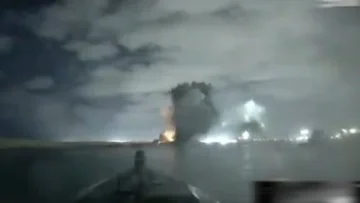
His remarks followed a strike by naval drones on a Russian warship docked at the port of Benghazi before dawn Sunday, which left two naval officers dead. A separate attack targeted a cargo vessel off Benghazi later that day.
Zelenskyy confirmed Tuesday that Ukraine was behind both attacks. He said Ukrainian forces had sunk the Russian corvette Merkury and struck the cargo vessel MV Angara, which he claimed Moscow used to transport weapons.
Asked about criticism from Italy over an attack on a Russian vessel inside a Libyan port, Zelenskyy acknowledged the risks but said Ukraine does not carry out such operations without coordinating with partners.
“Such actions are inherently very dangerous; however, I must emphasize that our forces never carry out attacks without coordination with our partners,” he said.
Ukrainian Foreign Minister Andrii Sybiha said Thursday that he had expressed regret over the “unintended consequences” of the drone strikes during a phone call with acting Libyan Foreign Minister Taher al-Baour.
Sybiha reaffirmed Ukraine’s support for Libya’s sovereignty and territorial integrity, and said Kyiv was ready to deepen bilateral cooperation in health care, food security, trade and other sectors.
“I explained to my counterpart that none of Ukraine's actions have ever been directed against Libya or the Libyan people, only against Russian military objects directly serving Russia’s war against Ukraine, expressed regret over the unintended consequences, and offered proper condolences to the Libyan people,” Sybiha said.
Libya remains divided between two rival administrations. Prime Minister Abdul Hamid Dbeibeh leads the administration in Tripoli, which controls the west of the country. The other administration, appointed by the House of Representatives in early 2022, is led by Osama Hammad and based in Benghazi; it governs the east and much of the south.