OMM Newsroom

Spain’s main party leaders held their final rallies ahead of Sunday’s election, with Socialist Prime Minister Pedro Sánchez saying he was confident of defying the polls, according to BBC World.
“I cannot imagine us losing,” Sánchez said as he posed for selfies with supporters in red T-shirts. He accused conservative rival Alberto Núñez Feijóo of planning a coalition with the far right.
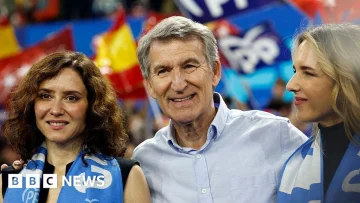
Feijóo’s People’s Party (PP) was narrowly ahead in the polls. In the final hours of the campaign, he travelled to Barcelona and then Seville, promising voters a new political era of “truth, decency and good governance”. He accused Sánchez of avoiding questions about corruption, rail disasters, immigration and the national debt.
Sánchez leads one of Europe’s few left-wing governments. With the French presidential election five months away, there is a possibility that two of the continent’s largest economies could shift to the right in quick succession.
Almost 39 million people are eligible to vote in Spain. Commentators expect a high turnout, while most polls have pointed to a close contest. Spanish electoral law prohibits the publication of polls after Monday.
“This time, yes, we’re going to do it,” Feijóo told PP supporters, referring to his failure to form a government three years ago despite his party winning the most seats.
If Feijóo forms a government this time, he is expected to rely on support from Vox, led by Santiago Abascal. The party held its final rally in a bullring in Valencia, on Spain’s east coast. Speaking earlier in Tarancón, south-east of Madrid, Abascal said Sánchez’s government “has betrayed us, he has robbed us and he has lied to us”.
Vox hopes to nearly double the 33 seats it won three years ago. Its policies include “national priority”, which would put Spanish citizens first in access to welfare, and “remigration” for foreigners it considers not to be contributing to the economy.
The campaign’s final day came after a four-way televised debate the previous night highlighted Spain’s sharply polarised politics. All four leaders offered proposals to address the housing crisis: Feijóo said the PP would build one million homes over four years, while Sánchez argued that housing should be a right, not an object of speculation and profit.
Conservatives sought to focus attention on scandals that have overshadowed the Socialists’ time in office, while Sánchez and his left-wing ally Ada Colau, leader of Frente Amplio (The Broad Front), focused on women’s rights.
The two left-wing leaders seized on a moment in the debate when Feijóo accused Colau and the rest of the left of remaining silent during a flood disaster in Valencia, briefly moving his finger to his lips. The word he used, “calladita”, is a diminutive that can also be used condescendingly to tell a woman to “keep quiet”. Sánchez responded by calling on Feijóo to show “a little respect” and accusing him of sexism.
On Friday, Feijóo sought to clarify his remarks and accused Colau of remaining silent during “these years of corruption”. His decision to end his campaign in Seville was significant because Andalusia has 61 of the 350 seats in Spain’s parliament, more than any other region.
Andalusia is also governed by a PP-Vox coalition, as are three other regions: Extremadura, Aragón and Castilla y León. Feijóo has said he wants to govern with a majority, supported by “parliamentary support agreements” with Vox. He says he has never spoken to Abascal about giving Vox ministerial posts.
Sánchez appeared on stage in Madrid with his wife, Begoña Gómez, wearing a red T-shirt bearing the words “power of the people”. He praised Colau and her left-wing coalition’s campaign. Speaking to a large audience in southern Madrid, Colau said they would “not remain silent, we will win” and vowed to form another “progressive government”.