OMM Newsroom
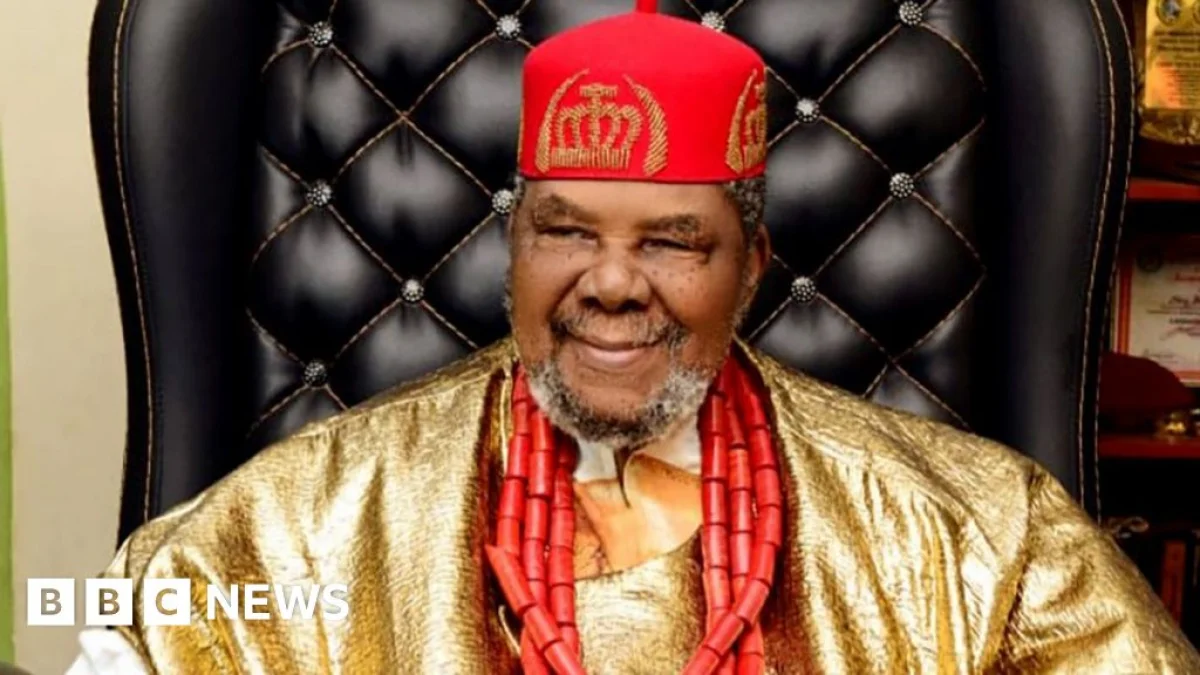
For generations of Nigerians, Pete Edochie was more than a celebrated actor. He was Okonkwo, the fierce, proud and troubled warrior whose portrayal in “Things Fall Apart” made him a household name and earned him a place in the hearts of millions.
Even after his death, many Nigerians continued to refer to him by the character’s name, reflecting the lasting impact of the role that defined his career. Edochie died on 25 November, aged 79, in Enugu, south-eastern Nigeria, after a prolonged battle with prostate cancer, according to the BBC.
Edochie starred in a 1987 television adaptation of Chinua Achebe’s acclaimed novel. The performance established him as one of Nigeria’s most respected actors and brought him international recognition. The series depicted an African community grappling with the changes brought by British colonial rule and Christianity.
Joy Nnamdi, a fan of both the novel and its television adaptation, said Edochie was the ideal choice for the lead role, adding that nobody else could have brought Okonkwo to life as convincingly.
“His character Okonkwo gave a face to the highly celebrated novel,” she told the BBC in Lagos, Nigeria’s largest city.
The role also cemented Edochie’s reputation as a tough screen presence, an image he maintained through much of his career.
“It was very rare to see him laugh in movies. He was the ultimate tough man,” Nnamdi said.
With a deep, authoritative voice, an imposing presence and a command of African proverbs, Edochie could dominate a scene without raising his voice. He became a familiar embodiment of patriarchal authority, playing characters ranging from village elders and wealthy businessmen to feared traditional rulers.
He went on to become one of the most recognisable faces of Nollywood, Nigeria’s film industry, which has grown into one of the world’s largest. “MultiChoice”’s “Africa Magic” channels helped bring his films into millions of homes across Africa, from Kenya to South Africa, as Nollywood grew into a continent-wide cultural phenomenon.
Many of Edochie’s films drew on Igbo culture, but their themes—including family loyalty, inheritance disputes, spiritual beliefs and the abuse of power—resonated with audiences well beyond Nigeria.
Before becoming a household name in film, Edochie had built a successful broadcasting career. Born on 7 March 1947 in Zaria, northern Nigeria, he attended primary and secondary school in Kaduna before studying journalism and television at the School of Journalism and Television in the UK.
He joined the Eastern Nigerian Broadcasting Corporation in 1967, the year Nigeria’s civil war began. He later joined the pro-separatist Voice of Biafra and described the war years as the greatest personal challenge he had faced.
“During the war, the experience that we had as Biafrans, you know, survival was difficult. Hunger was driving us into eating all sorts of nonsense,” he recalled.
After rising to senior management positions, Edochie switched to acting. Over a career spanning several decades, he appeared in numerous films, including “Igodo”, “Rituals” and “Billionaire’s Club”.
His career bridged the move from home-video productions to global streaming platforms. The 2018 romantic comedy “Lionheart”, which became “Netflix”’s first original Nigerian film, introduced his work to a wider international audience.
He also worked in Ghana, starring alongside some of the country’s biggest film stars in the 2017 comedy “John and John”.
Edochie’s contribution to the arts was recognised in 2003, when he received one of Nigeria’s national honours, the Member of the Order of the Niger (MON). He also received several other accolades, including the Industry Merit Award at the Africa Magic Viewers’ Choice Awards.
In recent years, Edochie found a new audience online. His distinctive expressions, witty remarks and memorable film scenes became popular social media memes, introducing his work to a younger generation of Africans.
For many who had never seen “Things Fall Apart” or his early Nollywood films, his stern expressions became a humorous way to convey disbelief, disapproval or exasperation at everyday situations. But to those who grew up watching him, his formidable screen presence was no joke.
Sani Muazu recalled that parents in Kano, northern Nigeria, sometimes invoked Edochie’s name to keep misbehaving children in check.
“They would tell you: ‘Okonkwo will come and visit you if you don’t stop’ and we would begin acting right,” he said.
“To be honest, we grew up scared of him. Even though he was on the screen and not physically present, some of his roles added to our fears because he played some popular occultic roles, and villain roles suited him.”
Tributes from fans and fellow actors followed news of his death, with many describing him as a giant who helped shape Nigeria’s film industry. Actress Genevieve Nnaji paid tribute in a post on X.
“I will let the assurance of the fact that you are a chosen one; and therefore, have returned to the most high God override my grief and heartbreak. May the heart of a true lion forever rest in peace. We love you,” she wrote.
Patience Ozokwor, known as Mama G, appeared alongside Edochie in several productions and remembered him as a brilliant actor and a source of wisdom.
“He has been a father to stories that are told, like an elder sitting down telling you how things were done in those days,” she told BBC News Pidgin.
“I called him any time, any day. He’ll tell you what to do and what not to do.”
Film director Babangida Bangis told the BBC that Edochie’s death was a loss not only for Nigeria and Africa, but for the global film industry.
“Just days ago, during a seminar for filmmakers across the country, his name popped up as an example of brilliance on the screen, longevity and professionalism,” he said.
“I think his loss is one for the world, not just Nigeria or Africa. We all grew up watching and loving him.”
Nigeria’s President Bola Ahmed Tinubu also mourned the actor, calling his death a major loss to the country’s film industry and cultural heritage. Tinubu singled out Edochie’s portrayal of Okonkwo, saying that performance and his later roles had established him as one of Nigeria’s most accomplished actors.
Beyond the fame and the formidable characters he played, Edochie’s family remembers him for the importance he placed on honesty and telling the truth. His son Leo Edochie told the BBC that his father was strong-willed.
“Of all his legacies, I think the whole world would agree that these two were the most important: telling the truth and remaining honest,” he said.
Leo described his father as a man who lived an exemplary life and offered young people a model to learn from and aspire to follow.
“I don’t really have a choice, but the truth is that I have to carry on that legacy for our family,” he added.
Edochie’s influence also extended to his family: two of his six children, Yul and Linc Edochie, followed him into Nigeria’s film industry.
Some of the actor’s most endearing moments came when he let his guard down. In 2021, he made a brief appearance in music star Phyno’s video for the song “Highway”, surprising fans with dance moves that showed a more playful side of the septuagenarian.
The appearance showed that the man behind the formidable screen persona could also laugh, dance and enjoy himself.