OMM Redaksiyası

France’s police watchdog, the General Inspectorate of the National Police (IGPN), is investigating 24 incidents linked to student protests across the country. One concerns 14-year-old Eden, who suffered a broken jaw and damaged teeth during a protest. He is reported to have been injured by a police projectile.
Eden was injured during student protests in Saint-Ouen-l’Aumône. According to the local prosecutor, he was sitting and looking at his phone a few metres from the demonstration. A police officer approached him and struck him with a baton. Eden kicked the officer in response, after which another officer fired a tear-gas grenade from a “Cougar” launcher. The grenade struck the teenager in the face.
Eden’s lawyer, Elsa Marcel, said a police officer hit him in the mouth and left him on the ground without calling emergency services. According to the prosecutor’s office, eight days after the incident a formal investigation was opened into the officer on suspicion of causing injury in the course of official duties resulting in permanent disability or disfigurement.
Other people have reportedly sustained eye injuries or lost their sight after being hit by rubber bullets during student protests that have continued for more than two weeks. In Lens, a 15-year-old is alleged to have lost a hand after being struck by a stun grenade.
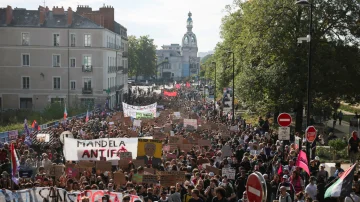
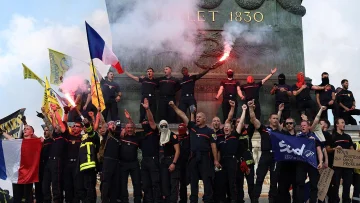
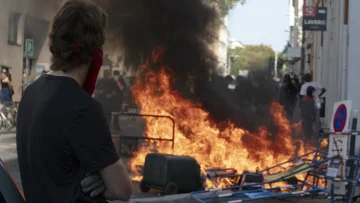
French Prime Minister Sébastien Lecornu has described the demonstrations as the most violent protests in decades. Interior Minister Laurent Nuñez said about 200 students had been injured. Officials also said nearly 700 police officers were injured and 6,887 people, most of them minors, were detained.
Teachers and others have also been attacked during the protests, while several schools have been set on fire or looted.
Use of less-lethal weapons debated in France
The incidents have renewed debate over French police use of weapons described as “less-lethal,” including rubber bullets and stun grenades. France is one of the few European countries where such weapons are used to maintain public order. They are not used for this purpose in the United Kingdom, Italy or Germany, with the exception of Hamburg.
Human rights groups, including Amnesty International, and some politicians have called for a complete ban on these weapons, citing their potential to cause serious injuries.
Balli Bagayoko, a mayor from the left-wing France Unbowed party, told Reuters that the use of rubber bullets should end and that the number of injured students should be reduced to zero. He said this would help ease tensions.
Police unions, however, say such weapons are needed to maintain order during violent demonstrations and protect officers. Union representative Thierry Cler called the injuries suffered by Eden and the teenager who lost a hand tragic, but said the incidents should not lead to an outright rejection of France’s approach to policing.
Cler linked the escalation of tensions to violence by some young protesters and said police needed appropriate means to respond to confrontations. “When people move towards confrontation, how are we supposed to respond? If we take away intermediate-force weapons, all we have left is lethal force. That is simply unthinkable,” he told Reuters.