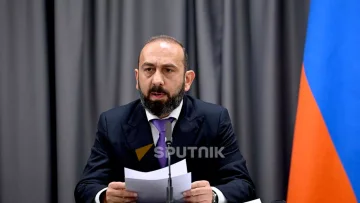
Afət Ziyadqızı

Ararat Mirzoyan, Armenia’s minister of foreign affairs and international partnerships, said Iran had officially asked Yerevan whether the “Trump Route” (the TRIPP project) would involve a US military presence and had received a negative answer. Mirzoyan made the remarks while commenting on Tehran’s position on the project.
Operative Information Center-OMM reports that the Armenian minister said Yerevan considered Iran’s concerns natural:
“It is entirely normal for the Iranian side to ask such questions. We gave them the necessary answer. Tehran said that if no military presence is envisaged, that is a positive development, because under those circumstances they, too, will be able to use the transit corridor and railway without difficulty,” Mirzoyan stressed.
He also alleged that Iran’s position on the project is sometimes deliberately exaggerated and misrepresented in Armenia.
Asked about Iranian officials’ warnings that the military and political involvement of third countries could undermine stability in the South Caucasus, Mirzoyan said he agreed with the principle: “It is a well-known reality that the military presence of a third party can complicate the security environment of other neighboring states,” he added.
Last month, Iran’s ambassador to Yerevan, Khalil Shirgolami, said Tehran had proposed establishing a bilateral mechanism for special consultations and an exchange of views to address its concerns about the TRIPP project. The Iranian diplomat said Tehran had openly conveyed its concerns, citing the US administration’s policy toward Iran, but that the issues could be resolved in a spirit of good neighborliness.
TRIPP, the “Trump Route for International Peace and Prosperity,” envisages opening a transit corridor through Armenia’s Zangezur (Syunik) province. Under the project’s terms, the route is to remain under Armenian jurisdiction and must not undermine the country’s sovereignty.
Under the document, Armenia grants the United States exclusive long-term rights of up to 99 years to develop and operate the route. Azerbaijan aims to establish unimpeded land and transport links with the Nakhchivan Autonomous Republic through the corridor. The project envisages a US company holding a controlling stake, while Yerevan retains authority over key mechanisms. An initial ownership split of 74% for the United States and 26% for Armenia has been proposed; Armenia’s share is expected to rise to as much as 49% if the agreement is extended. The parties signed the relevant framework agreement in early June.