OMM Newsroom

Nationwide protests are expected to begin in France on Saturday, with students, trade union members and former participants in the Yellow Vest movement set to demonstrate over rising living costs, inequality and public spending.
According to AnewZ, the protests began last month at high schools in low-income areas north of Paris. Students complained that teachers were absent from classes and that school conditions were deteriorating. The movement later grew to encompass broader concerns about rising living costs, inadequate public services and declining living standards.
Prime Minister Sebastien Lecornu acknowledged growing public discontent on Thursday and said authorities feared new unrest. “The country is going through a period of fatigue. We are in a constant state of crisis: wars, inflation and issues related to purchasing power,” Lecornu said.
France is also facing pressure over its public finances. Investors are selling the country’s government bonds, pushing borrowing costs to their highest level in more than two decades.
The unrest comes as President Emmanuel Macron’s government faces mounting economic and political pressure, with the political landscape deeply fragmented. Macron is approaching the final phase of his presidency.
Authorities fear possible violence
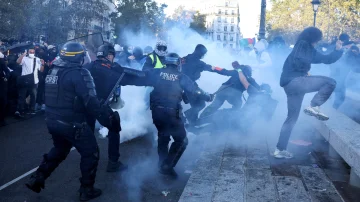
French authorities have voiced concern about possible clashes during Saturday’s demonstrations, following weeks of unrest. Lecornu described the protests as among the most violent of recent decades and said more than 900 police officers had been injured since the demonstrations began.
Police tactics have also drawn criticism. Protesters have reportedly suffered serious injuries, including a teenager who lost a hand after picking up a stun grenade. France’s internal police oversight body is investigating at least 24 allegations of police violence.
Although the use of stun grenades was halted during student protests, Interior Minister Laurent Nunez said they could be used at Saturday’s demonstrations. “If clashes break out, all types of intermediate-force equipment may be used,” he told Télématin in an interview on Friday.
The government has accused the France Unbowed (LFI) party of encouraging the unrest, a charge the party denies. Jordan Bardella, leader of the right-wing National Rally party, warned of possible violence, saying he believed France was heading for “a day of chaos.”
Former Yellow Vest protesters may join demonstrations
The possibility that former participants in the Yellow Vest movement will join Saturday’s protests has raised concerns that the demonstrations could grow. The movement began in 2018 in opposition to fuel taxes before expanding into nationwide protests against rising living costs and income inequality.
Yannick Maillou, a teacher from the western French town of La Crèche who took part in the 2018 protests, said several gathering points had been organized for Saturday and that trade unions were also urging members to demonstrate. “Teams are being formed to provide medical assistance in case of police violence,” he said.
Another former Yellow Vest protester, Myrtil Devillers, said she understood the demonstrators’ range of grievances and pointed to rising fuel prices. “I was a Yellow Vest when a litre of petrol cost 1.40 euros. Imagine how I feel seeing it at 2.20 euros now,” she said. The source also gave the prices as the equivalent of $1.57 and $2.47, respectively.
Devillers said there was discontent in education, health care, the justice system and business. “The justice system is unhappy; the education system is unhappy; the health sector is unhappy; my friends in business are unhappy,” she said.
As concerns about purchasing power bring together students, trade unions and former Yellow Vest protesters, Saturday’s demonstrations could become a major test for the French government as it faces mounting economic and political challenges.