 OMM Redaksiyası

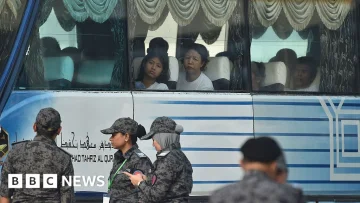
Young men in Hpa-An, the capital of Myanmar’s southern Karen state, are avoiding the streets after dark amid reports that junta supporters are arresting people and forcing them into military service, according to the BBC.
A 26-year-old tuk-tuk driver, identified by the BBC as Zaw Min, said he fears going out but must work. He said his family regularly warns him not to take passengers too far and to remain alert. Some people he knows have been taken, he added.
Leaked documents seen by BBC Burmese indicate that authorities have been ordered to meet military recruitment quotas aggressively. The junta is fighting ethnic militias, pro-democracy groups and civilian-led resistance movements.
Myanmar has been in civil war since the military seized power in February 2021 and ousted elected leader Aung San Suu Kyi. In 2024, after suffering battlefield setbacks and desertions, the junta enacted a conscription law requiring men aged 18 to 35 and women aged 18 to 27 to serve for at least two years. Those who refuse face up to five years in prison.
Maj Naung Yoe, a military affairs official at the Myanmar Defense and Security Institute and a former military officer who joined the anti-coup Civil Disobedience Movement, described the law as one of the most severe measures imposed on civilians since the coup.
Hpa-An is the latest area caught up in a recruitment dragnet that has ensnared an estimated 100,000 young people over the past two-and-a-half years, many through coercion, extortion or abduction. Naung Yoe said security forces track young people, arrest them under the pretext of military eligibility and demand money under threat of detention.
The BBC said Myanmar’s Central Body for Summoning People’s Military Servants declined to comment on allegations of forced recruitment and recent abductions.
International rights groups, including Amnesty International, Human Rights Watch and Fortify Rights, have said Myanmar’s military is abducting civilians and compelling them to serve. In July, research group Myanmar Witness reported that it had analysed hundreds of missing-person notices posted on Facebook from 2021 to 2025. Notices for January rose from four in 2021 to 82 in 2025, after the conscription law was introduced.
The researchers said recruitment appeared in many cases to involve detention, coercion and people disappearing without their families being informed, rather than formal call-ups. Men and boys made up most of the reported missing people.
In Yangon, Ma Moe San Pan told the BBC that her 33-year-old husband, Phyo Wai, disappeared after leaving home on 8 May 2025. Two days later, he called her from a military recruitment centre across the city.
She said her cousin, who worked at a ward administration office, had taken Phyo Wai there. According to her account, the office transferred him to another ward for 4 million kyats, about $900, to meet that ward’s recruitment quota. The BBC was unable to reach the cousin.
Ma Moe San Pan said she was later defrauded of 4.5 million kyats by people who falsely promised to secure her husband’s release. The administrator of the ward where Phyo Wai was taken acknowledged to the BBC that he had helped send him to military recruitment authorities, but denied that money had changed hands. He said transfers between townships occur when local quotas cannot be met.
Ma Moe San Pan said her husband told her he had been promised help and then made to sign documents. She has filed police complaints about his alleged sale into military service and the money taken by the scammers, but said police refused to add a human trafficking charge, telling her such a case could be registered only if someone had been sold abroad. She does not know where her husband is now.
Naung Yoe said pressure to meet quotas has created incentives for officials and others to seize recruits. Methods include arrests at road checkpoints, ambushes of workers on their commutes, fake job offers and forced entry into homes. He described the practices as a form of modern slavery and human trafficking.
In late August, police in Yangon arrested a Fire Services Department member and his son-in-law over the alleged abduction of four young men for military conscription. The reserve fire brigade unit commander was accused of luring them to his home with job offers and confining them in purpose-built rooms. He was arrested on 25 August and charged with kidnapping or abduction for wrongful confinement, an offence carrying a possible sentence of up to seven years.
Naung Yoe said lower-level administrators, military personnel and local criminal groups use different tactics to arrest young people and sell them to units facing manpower shortages. He added that some recruits are supplied as substitutes for wealthier people seeking to avoid service.
Although recruitment orders require villages, wards and townships to provide quotas based on population, wealthier people can pay to avoid conscription, leaving poorer residents to bear a disproportionate burden, the BBC reported.
Dr Sandeep Singh, a military studies research fellow at the National University of Singapore, said the drive to recruit unwilling young people reflected the junta’s difficult position in the civil war. The threat of forced service has added to displacement, labour shortages and departures to neighbouring countries, while deepening the strain on young people and their families.