OMM Redaksiyası

France is facing its largest student protests in decades after a demonstration in support of striking teachers at a high school north of Paris grew into a nationwide movement, CNN reported.
Hundreds of schools have been forced to close, and more than 5,000 people have been taken into police custody. Most are minors with no previous criminal records. Students, teachers and police officers have been injured.
One student in the north-eastern city of Lens reportedly lost a hand after picking up a grenade, while another in Tours lost an eye. Thousands of people are expected to join protest marches across the country on Tuesday, in a major test for the government.
The protests began on September 21 at Saint-Exupéry High School in a Paris suburb, where students joined teachers calling for more staff and resources. The strike ended after additional staff were sent to the school, but demonstrations had already begun to spread.
Student leader Manès Nadel said an unprecedented number of schools had become involved and accused the Education Ministry of being overwhelmed by the crisis.
Students began blocking entrances to high schools in Paris and the surrounding region. Similar protests soon followed from Lille in the north to Marseille in the south. More than 100 high schools have been damaged since the movement began.
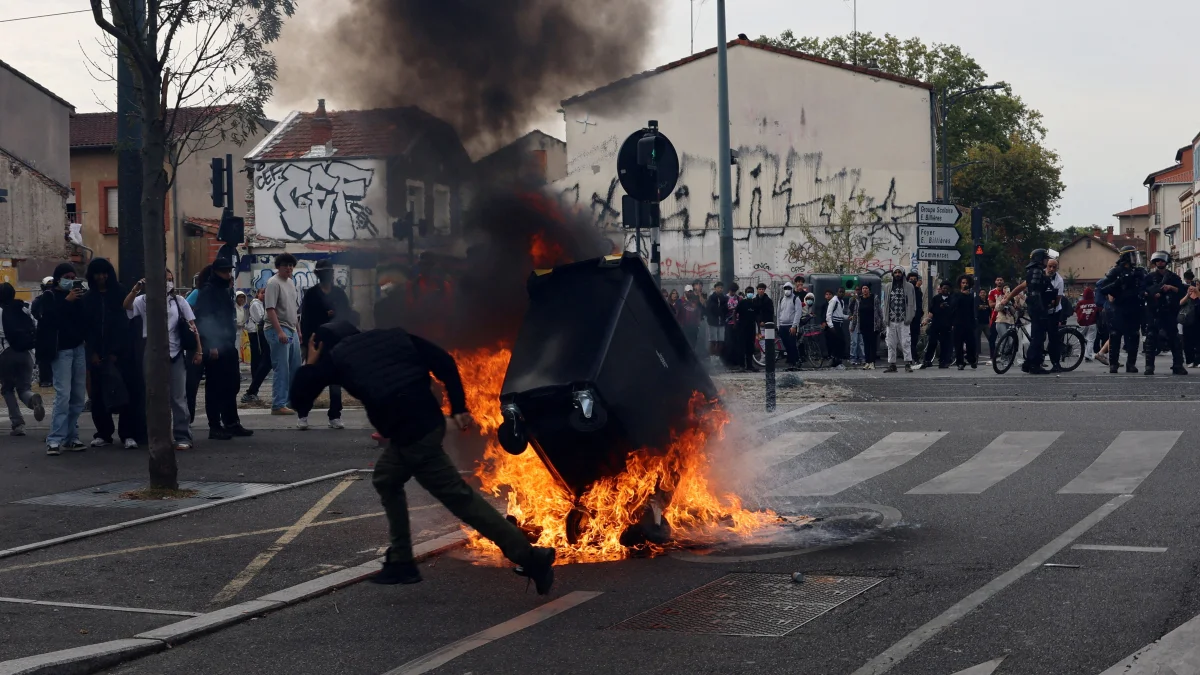
Images of burning rubbish bins, barricades and clashes with police have prompted questions about the police response and the involvement of the far left. Critics have accused officers of using excessive force. In Alençon, one officer was filmed using a headlock on a girl, a technique prohibited by law.
Students’ grievances include overcrowded classrooms, inadequate equipment and staff shortages. Secondary schools have fewer teachers than in 2008, despite having 250,000 more students. In the public sector, 70% of classrooms have more than 30 pupils.
Critics say the government was slow to address the protests and initially focused on the far-left LFI party and its presence at the barricades. The party, led by Jean-Luc Mélenchon, has defended both the students’ right to protest and its own right to take part.
Damage to schools in the greater Paris region alone is estimated at 7 million euros ($7.84 million). A planned fee increase at technological high schools, due to take effect in 2027, was initially dropped but has since been removed from the government’s budget.
“The government’s response has been irresponsible and it confirms exactly why the students are angry, because they are never heard,” Nadel said. “They are responding only with repression.”
Education Minister Edouard Geffray met student leaders on Friday, but the talks produced no agreement. The student representatives then called for a large turnout at Tuesday’s demonstrations.
The government is also trying to pass a 2027 budget that would bring the deficit down to about 5% of gross domestic product. France’s 10-year bond yield briefly exceeded 5% last week, its highest level since 2002, amid concerns about the country’s finances.
The protests have emerged as the far right and far left prepare for a presidential contest, while centrist forces are struggling in opinion polls. Student demonstrations have previously posed a challenge to French governments: the May 1968 protests grew into the largest strike in the country’s history.
This time, students say they are seeking what they consider basic conditions: an education system that allows them to learn.