 OMM Redaksiyası

Fida al-Toutah was combing her daughter’s hair in the family’s tent in central Gaza when gunfire erupted. Her son Ezz recalled that his grandmother shouted for everyone to get down; he realised his mother had been shot when he saw blood on his younger brother’s hands.
Al-Toutah, 31 and a mother of five, died from a gunshot wound to the head on 21 September. Her husband, Ahed, told the BBC: “Every day there’s a shooting. Every day there is killing and death lurking around.”
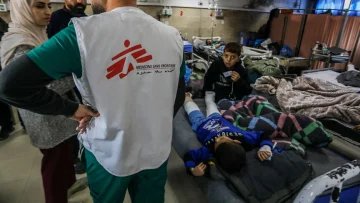
More than 1,400 people have been killed in Israeli attacks in Gaza since the ceasefire started on 10 October last year, according to the Hamas-run health ministry. The United Nations considers the ministry’s figures reliable. In the past week alone, more than 30 people were killed, it said.
The ceasefire brought an end to large-scale Israeli bombardment and enabled increased deliveries of humanitarian aid and medical supplies. It also provided for the release of thousands of Palestinians held by Israel in exchange for the 48 remaining hostages in Gaza, as part of an agreement intended to end the war.
The war began after the Hamas-led attack on Israel on 7 October 2023, in which about 1,200 people were killed and 251 taken hostage. The Gaza health ministry says the death toll from Israeli attacks since the start of the war has now exceeded 74,000.
Israel says it targets Hamas operatives and accuses the group of continuing to violate the ceasefire. Asked about al-Toutah’s death, the Israel Defense Forces (IDF) told the BBC it had no record of the incident.
Her brother Ibrahim pointed to holes in the family’s tent, which he said were caused by bullets fired by Israeli forces. He said his sister was the fourth of his siblings to be killed during the war. The family had left the Zeitoun neighbourhood and moved seven times, he said, but had not found safety.
On the same day al-Toutah was killed, 14-year-old Ismail al-Bardawil was shot dead in the al-Mawasi area of Rafah, in southern Gaza. His family told the BBC that Israeli forces shot him while he and his brothers were fishing about 20 metres from shore. The health ministry says he was one of more than 300 children killed since the ceasefire began. The IDF said it had no information about the incident.
Both victims lived near the so-called Yellow Line, separating areas occupied by the Israeli military from areas controlled by Hamas. The area around the line is considered especially dangerous, while limited space restricts people’s ability to move elsewhere.
The United Nations says most of Gaza’s 2.1 million residents have been displaced multiple times. The population is now concentrated in less than 40% of the territory, in areas controlled by Hamas, where the group continues to recruit fighters and suppress dissent.
Amal Alabadla, an architect who lived in a flat before the war, now raises her two sons in a tent on the coast. She said rain floods the tent and strong winds can damage it. Her husband has been away from Gaza since the war began, and her three brothers, who helped care for her children, were killed in separate attacks before the ceasefire.
Alabadla said the cold causes her son to suffer epileptic seizures and makes it difficult to keep him warm and dry. “Before the war, I had a job, a house, an ordinary life,” she said. “Now we have no hope, nothing. It’s only about survival day by day.”
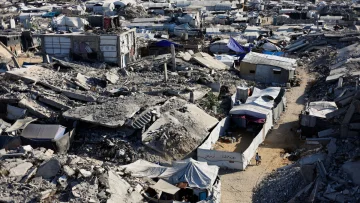
An agreement reached in October 2025 was intended to lead to Gaza’s reconstruction, but rebuilding has not begun amid a stalemate over the deal’s second phase. Israel controls which materials and machinery enter the territory, saying it does so for security reasons.
US President Donald Trump proposed a plan to disarm Hamas earlier this year. In August, Israeli Prime Minister Benjamin Netanyahu rejected it, saying there would be no military withdrawal until Hamas was “genuinely” disarmed. Hamas has said it will hand over heavy weapons only if Israel ends “all forms of aggression” and withdraws its forces from Gaza.
Trump’s Board of Peace has also proposed a $2.45bn recovery plan for Gaza. But, one year after the ceasefire and three years after the war began, Alabadla said she remained doubtful that conditions would change. “We are struggling and not being allowed to rebuild,” she told the BBC.