OMM Redaksiyası

Employees of the Azerbaijan National Academy of Sciences have issued a statement regarding what they described as an artificially created controversy in Armenia surrounding the Gandzasar Monastery.
"Operative Information Center-OMM" presents the statement:
“The deliberate uproar artificially created in Armenia in recent days around monuments of Caucasian Albania located in Azerbaijan’s Garabagh region, particularly the Gandzasar Monastery, is an attempt to generate cheap and meaningless sensationalism that has no connection with historical and scientific realities. In fact, the Gandzasar Monastery complex, including the monastery itself as one of its key components, is a historical monument belonging to Caucasian Albania and has no connection with Armenian history. The fact that this monument belonged to Albania and its local population—the Albanians—has long been established by indisputable historical and archaeological evidence. One of the most important facts confirming this is that the Gandzasar Monastery was built in the historical geographic territory of Caucasian Albania, with which the Armenians have no connection. This area was one of the principal provinces of the state of Caucasian Albania and developed historically as part of it. Following the collapse of the Arab Caliphate, the rule of the Albanian kingdom was partially restored there. In the 12th and 13th centuries, the Albanian-Khachen principality rose in this area. Its ruler was Hasan Jalal, a prominent Azerbaijani statesman who lived from 1215 to 1261. Hasan Jalal and his wife were descended from the prominent Albanian Mehranid dynasty. Hasan Jalal, who bore the title of king or absolute ruler, was referred to in contemporary sources by titles including ‘prince of princes,’ ‘prince of the country of Khachen’ and ‘king of Albania.’
During Hasan Jalal’s rule, these historical lands of Azerbaijan experienced economic, political and cultural progress, and his era has been described as the Albanian Renaissance. The Gandzasar Monastery was built as an outstanding example of this renaissance.
An equal-armed cross, belonging to the Albanians, was used at the Gandzasar Monastery. The equal-armed cross served as the seal of the Albanians. The monastery was built using local construction materials from the region.
Moreover, the epigraphic inscriptions on most monuments in the Garabagh region, as well as those at the Gandzasar Monastery, consist of texts belonging to the Albanians. These epigraphic inscriptions are the monastery’s stone inscriptions. A book on the Gandzasar inscriptions, published in Petrograd in 1919 and deliberately destroyed by Armenians during the same period, also confirmed that these monuments belonged to the Albanians. The frescoes, or wall paintings, inside the monastery provide further visual evidence that the monument is part of Albanian heritage.
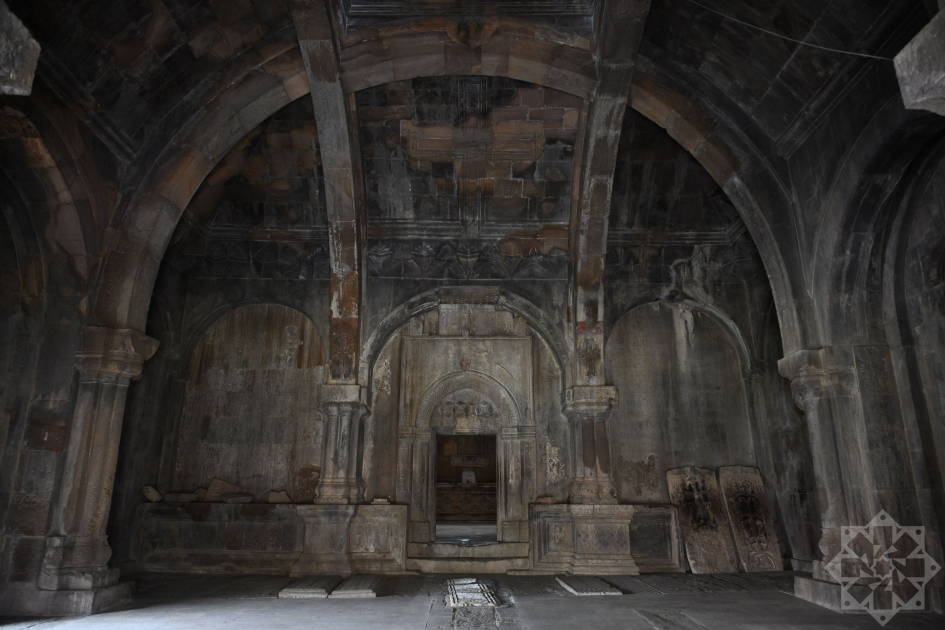
Armenians undertook deliberate measures to Armenianize the Gandzasar Monastery during the Soviet period and later during the occupation. Albanian epigraphic monuments at the monastery were destroyed or dismantled, taken to Armenia and replaced with distorted Armenian texts. At the same time, the equal-armed Albanian cross on the Gandzasar Monastery was altered into a Gregorian cross of a different form. The graves of Albanian catholicoi inside the monastery were also interfered with, and their original structures were changed. During the occupation, Armenians also damaged the monument’s original appearance by using construction materials brought from Armenia under the guise of restoration.
Although these are the scientific and historical realities concerning the monuments of Caucasian Albania, including the Gandzasar Monastery, the dissatisfaction expressed in Armenia after Azerbaijani diplomats observed distortions made by Armenians during a visit to the liberated territories is nothing more than an attempt to conceal the truth.
We believe that the controversy raised by Armenia around the Gandzasar Monastery has no scientific or historical basis and is currently aimed at undermining the peace agenda put forward by the Azerbaijani state. This provocation is a continuation of Armenia’s longstanding policy of appropriating Azerbaijan’s national and spiritual values and culinary traditions, and artificially claiming Azerbaijan’s monuments as its own. It demonstrates that forces in Armenia that have not abandoned the fiction of a ‘greater Armenia’ are seeking to disrupt steps currently being taken in their country toward facing reality.
Azerbaijani scientists strongly condemn the deliberate campaign being fueled in Armenia around the Gandzasar Monastery and call on the Armenian side to approach scientific truths objectively rather than relying on artificial and false propaganda.
Isa Habibbayli, president of ANAS, academician
Govhar Bakhsheyeva, vice president of ANAS, academician
Ismayil Hajiyev, chair of the Nakhchivan Branch of ANAS, academician
Teymur Karimli, director of the Institute of Manuscripts named after Muhammad Fuzuli of ANAS, academician
Nargiz Akhundova, academician
Artegin Salamzade, director of the Institute of Architecture and Art of ANAS, corresponding member of ANAS
Hajifakhraddin Safarli, corresponding member of ANAS
Konul Bunyadzade, corresponding member of ANAS
Vali Bakhsheyev, corresponding member of ANAS
Jafar Giyasi, corresponding member of ANAS
Karim Shukurov, director of the Institute of History and Ethnology named after Abbasgulu Agha Bakikhanov of ANAS, doctor of historical sciences, professor
Ilham Mammadzade, director of the Institute of Philosophy and Sociology of ANAS, doctor of philosophical sciences, professor
Farhad Guliyev, director of the Institute of Archaeology and Anthropology of ANAS, PhD in history, associate professor
Kubra Aliyeva, doctor of arts, professor
Gafar Jabiyev, doctor of historical sciences, professor
Aliaga Mammadli, doctor of anthropology, professor
Allahverdi Alimirzayev, doctor of historical sciences, associate professor
Ramil Agayev, doctor of historical sciences, associate professor
Rahiba Aliyeva, doctor of architecture
Natiq Alishov, PhD in history, associate professor
Tavakkul Aliyev, PhD in history, associate professor
Taleh Aliyev, PhD in history, associate professor
Telman Ibrahimov, PhD in arts, associate professor
Ellada Bakirova, PhD in history, associate professor
Vagif Asadov, PhD in history, associate professor
Ulviya Hajiyeva, PhD in history
Gulana Aliyeva, PhD in history”.