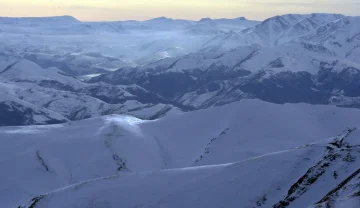
The latest data on the actual weather conditions in Azerbaijan has been released, indicating a continuation of unstable weather patterns across the country. According to the report from the National Hydrometeorological Service as of 10:00 AM on April 13, intermittent lightning and rain have been observed in various regions. Operative Information Center-OMM reports that precipitation has been particularly intense in the Balakan-Sheki region, while snow continues to fall in mountainous areas.
The height of the snow cover has reached 90 cm in Shahdag, 27 cm in Zagatala (Alibay), and 10 cm in Gryz. Other mountainous and liberated territories also recorded snow accumulation, including 8 cm in Dashkasan and Khinalig, 5 cm in Gadabay, 4 cm in Gakh (Saribash) and Gusar (Laza), 3 cm in Kalbajar, 2 cm in Lachin, and 1 cm in Shusha and Khankendi. The volume of rainfall was highest in Oguz and Balakan at 38 mm, followed by Gakh (32 mm), Sheki (31 mm), and Mingachevir (23 mm). Significant precipitation was also recorded in Yevlakh, Gabala, Sadarak, Goranboy, and Naftalan, with lighter amounts observed in Nakhchivan, Ganja, Qubadli, and Fuzuli.
In addition to the precipitation, strong north-westerly winds have swept across the Republic. The maximum wind speed reached 28 m/s in Baku and the Absheron Peninsula, 22 m/s in Mingachevir, and 21 m/s in Yevlakh. Foggy conditions are currently prevailing in several regions, including Dashkasan, Goygol, Sheki, Guba, and Lerik, where visibility has been restricted to 500 meters. Such weather fluctuations are characteristic of the transitional spring season in Azerbaijan, where the interaction of cold air masses from the north and humid currents often leads to rapid changes in atmospheric pressure and temperature across the country's diverse climate zones.