OMM Redaksiyası

Palestinian Prime Minister Mohammed Mustafa has urged countries that recognise the State of Palestine to turn diplomatic support into concrete political and economic measures, according to the source article.
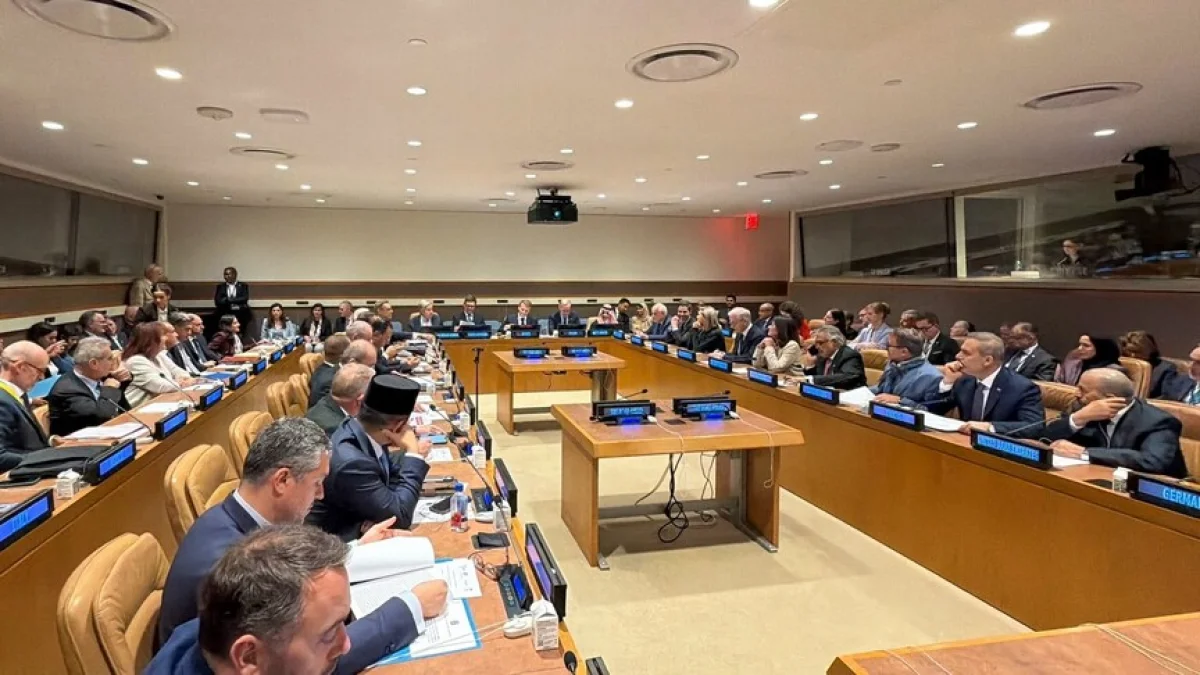
Speaking to foreign ministers in New York at a high-level ministerial meeting of the Global Alliance for the Implementation of the Two-State Solution, Mustafa said recognition should lead to practical results rather than remain symbolic.
He called for Palestinian accession to international financial institutions, full membership in the United Nations and wider recognition of Palestinian sovereignty. Mustafa also said the international community must shift its focus from “state building” to “state realization” by strengthening institutions with a clear mandate to exercise sovereignty.
Palestinian territories face economic and humanitarian pressures
Mustafa warned that Israeli settlement plans in the E1 area were separating East Jerusalem and undermining the territorial basis of a two-state solution. He said the Palestinian administration faced a monthly funding shortfall of $200 million because clearance revenues were being withheld.
Unemployment, he added, had reached 50% across the Palestinian territories and nearly 78% in Gaza.
Nickolay Mladenov, the US-led Board of Peace’s high representative for Gaza, announced a $2.45 billion early recovery package covering 66 urgent projects. The projects will be administered by the National Committee for the Administration of Gaza.
Mladenov said reconstruction could not replace a political settlement. Rebuilding Gaza without self-determination, he warned, would create “a more comfortable confinement”. He added that reconstruction depended on security conditions and the decommissioning of weapons, while humanitarian access remained severely restricted and Palestinian casualties continued.
UN Assistant Secretary-General Ramiz Alakbarov described the conditions on the ground as critical. He warned that communities in southern Gaza located below sea level faced serious winter flooding because of untreated sewage and household waste.
Alakbarov called for restrictions on dual-use imports that hinder humanitarian assistance to be lifted. He also urged unified governance in Gaza and the West Bank under the Palestinian Authority.
Officials call for Gaza, West Bank unity
Saudi Foreign Minister Prince Faisal bin Farhan said Gaza must not emerge from the conflict politically or territorially separated from the West Bank and East Jerusalem.
“We cannot assume that the basis of this solution, the two-state solution, will persist,” he said, warning that expulsions and unilateral actions were eroding the prospects for a future settlement. “Every day, every delay has a price,” he added.
Norwegian Foreign Minister Espen Barth Eide said Norway’s formal recognition of Palestine had removed a bilateral veto that had impeded progress since the Oslo Accords. He said Oslo had recently increased direct budget support to help sustain Palestinian institutions.
Eide also said Norway was enforcing trade bans on goods originating from the Israeli occupation in line with rulings by the International Court of Justice.
European Union foreign policy chief Kaja Kallas said diplomatic declarations remained sharply “at odds with the hard realities on the ground”. She reaffirmed the EU’s support for forthcoming Palestinian legislative elections and said Brussels was implementing environmental pilot projects through its Team Gaza initiative.
Kallas also backed demilitarisation frameworks and the complete withdrawal of Israeli forces.